
 Michael Zimmerman
The Blueprint to High-Converting Apartment Websites
 Michael Zimmerman : August 25, 2025
Discover the blueprint for apartment websites that rank in AI-powered search, show real-time pricing, and convert high-intent renters into leases.
.jpg?width=5000&height=2667&name=MMP_Header%20(1).jpg)
QUICK SUMMARY // Marketing a large portfolio of apartment communities is daunting. Renters are changing how they search, AI tools are evolving fast, each property's demand is constantly changing, and you only have a certain amount of time and money to work with. Despite these obstacles, you're expected to develop a marketing strategy that generates qualified traffic, leads, and leases to keep communities full. We understand your challenges, so we wrote this guide to help you attract the right renters to your apartments—and to give you the marketing tools that'll help—based on real data from 95,000+ leases.
You’re about to pack up for the day when you get the alert in your PMS: three more notices just came in for that property in Houston. Occupancy is 87%—and declining.
You just increased its ILS package last month, hoping more visibility would help. But the phones aren't ringing, and there's not enough quality website traffic to improve leads. Great—as if there was any wiggle room in the budget to begin with.
Meanwhile, you've just spent all day focusing on the digital ad campaigns for a few of your struggling Florida properties, increasing your spending to stop their slide.
You're also combatting shifting renter behaviors, AI, and market forces that make keeping up with each property's marketing needs even harder.
This is the day-to-day reality for marketing an apartment portfolio. All of these challenges fall on your shoulders, but you don't have enough time to fix everything. The more problems that arise, the further you fall behind.
Yet you're still expected to maintain a marketing strategy that results in each apartment community continually getting qualified traffic, leads, and leases.
We wrote this guide for overwhelmed executive-level apartment marketers like yourself. In it, we'll walk you through:
Applied together, these insights create a scalable, sustainable apartment marketing plan for your entire portfolio—one that helps you address each community’s unique needs without falling behind, draining your budget, or guessing your way through the next crisis.
You're one step closer to a reality where each day doesn't begin with a new fire to put out. Let’s get started.
Why does marketing a larger portfolio of apartment communities feel much more difficult than it's ever been?
There's the obvious issues—smaller marketing teams, limited time capacity, budget constraints, and remaining reactive to unexpected changes in demand across multiple properties.
But we're also seeing these emerging challenges:
A prospective renter may interact with your digital ads, organic search results, online reviews, community websites, virtual tours, map packs, and ILS listings multiple times before you know they're even interested.
While we all would desire the ability to understand what steps those individuals took—from when and where they found your apartments and later converted—privacy changes and fragmented marketing channels leave most of us in the dark.
That leads many marketers to wonder if they're promoting their communities in front of the right renters at the right time in the right place, or knowing which sources are actually delivering good leads.
On top of not having a clear picture for what's currently working, AI tools like ChatGPT, Gemini, Perplexity, and others have evolved quickly—impacting the way prospective residents search for apartments.
These AI search tools handle the research and evaluation renters would've typically done themselves—and it's doing it for them in seconds. Renters put in very specific prompts about what they're looking for in an apartment community, and the AI produces natural, personalized answers curated from real content from multiple sources online.
AI makes the information you display about your communities—location, price, availability, features, and lifestyle—matter as much as the sources you choose to promote them on.
These emerging challenges have led to a lot of questions for portfolio-level apartment marketers:
Do standard SEO practices, like ranking organically at the top of Google searches, still matter?
Do I go all-in on social media marketing to attract today's younger renter demographic?
Is a high-performing website still worth the investment?
Are Google Ads still effective for getting in front of renters?
So if you're stressed and confused about what to prioritize when marketing apartments today, you're certainly not alone.
But there remains a pathway to success for attracting renters to your apartment communities despite today's marketing challenges—and it's scalable across your portfolio.
That pathway is:
The answers to many of the questions you're facing become clearer once you understand how modern renters search for apartments. Even if their individual leasing journeys are unique—and largely invisible until they convert—you can still position your communities effectively at the moments that matter.
And the most reliable way to do that is by using the Leasing Funnel framework.
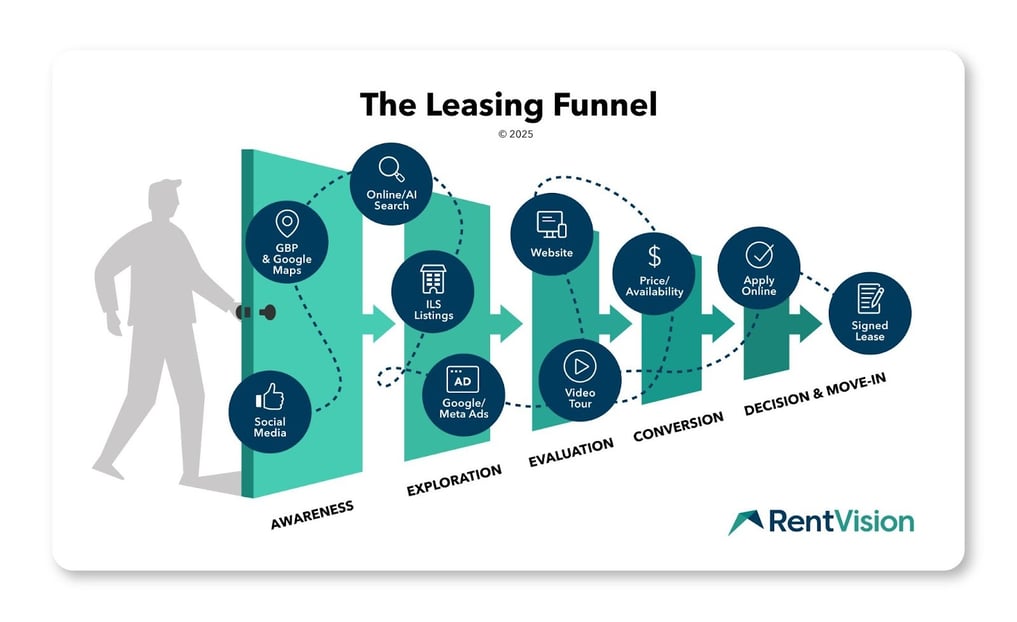
The Leasing Funnel clarifies how renters discover, explore, evaluate, and choose apartment communities. It’s a framework that breaks through the challenges you're facing because it aligns with every critical marketing and leasing activity, especially at the portfolio level.
No matter what channels renters use or which paths they take, every prospect still progresses through the same stages:
While certain marketing channels naturally fit with some stages more than others, this isn't just a series of tactics for getting renters from point A to B. (If only it could be that simple!)
The purpose of the Leasing Funnel is to show that promoting your apartments in front of the right audience, in the right place, and at the right moment in their search, increases the likelihood that they'll sign a lease.
Let's break down why this framework works today, and how to implement it so you're marketing your communities in the most consistent way possible.
Before beginning their apartment search, renters already know the basics: how many bedrooms and bathrooms they need, what location they prefer, what they can afford, and when they need to move.
Renters then begin searching for apartments that fit those defined needs using some familiar sources:
But increasingly, renters start their search in less traditional ways:
As a marketer, the objective of the Awareness stage is to focus on clearly communicating the value your communities offer—their amenities, floorplans, price points, availability, locations, etc.—in all of your marketing channels.
That means:
Who is the ideal resident profile for each community? What lifestyle do they want? What are their turn-offs? The more clarity you have on your target audience, the more you understand what content to feature.
On every platform you use, you need to include the details—floorplan types, location, policies, pricing, amenities—that instantly qualify your communities.
You don't need to be everywhere at once, but you do need to be present where intent actually exists—search engines, social platforms, reliable ILSs, maps, and now AI.
That way, no matter where in-market renters begin their search, you're presenting the details they're looking for. This will help your apartment communities have a stronger chance of being discovered first.
Renters enter the Exploration stage with a list of potential apartment communities fitting their needs. Their goal is to narrow their list of potential places they live.
To do this, renters may bounce back and forth across multiple sources to seek out as much context as they can for each community that's passed their initial checkboxes.
They'll start skimming various sources—especially community websites—to compare visuals, amenities, lifestyles, price, and availability to validate their opinion.
Then they'll look through reviews on your Google Business Profile and evaluate your responses. They find a Reddit thread about apartments in Charlotte and check to see if your community is mentioned. Then they'll head back to the website to watch a video tour of the floorplan they like.
While their Exploration process is messy and unpredictable, the easier it is for renters to research, compare, and develop trust in your communities, the more you're helping your case in keeping them on a path to leasing at your apartment.
You can do this by:
To give renters obvious answers to their questions, you need to have a website with floorplan-level details for each community. That gives them a clear source of truth to use to evaluate your communities against others.
To improve how renters evaluate your communities, have authentic video tours and photos showing the inside of the floorplan. Doing so sets a level of transparency that's valuable for building confidence and trust.
Knowing renters need social validation from your reviews, responding to every review and anchoring your messaging with positive feedback from your residents will help improve how they perceive your communities—especially if they're weighing multiple choices.
Now renters have reached the part of the leasing journey where they're down to a few good-fit communities they clearly like. But before committing to one, they'll ask themselves, “Where do I truly see myself living?”
The Evaluation stage is the emotional bridge of the Leasing Funnel, where in-market renters move on from browsing multiple marketing channels to becoming measurable leads.
At this moment, they're looking for reasons to say "Yes." They'll do this by:
To win at this stage, you need to focus on having a community website with content that answers your renters' most essential needs.
That includes:
When renters can get clear answers on your website, they notice. It shows you care about their needs. At this stage where your community is a final contender, that matters even more.
By this point, one apartment community has earned the trust and confidence of a prospective resident.
From discovering your community, to reviewing your website, to comparing floorplans, to checking your social channels, to browsing your visuals, to reading real renter experiences in online forums, and then circling back to your website to double-check their interest…now they're here.
Make what happens next frictionless. Renters should always be one click away from:
Establishing clear conversion pathways—like applying CTAs such as "Apply Now" or "Schedule a Tour" in high-intent spaces like your individual floorplan pages—is essential for the Decision stage.
You've worked too hard to get them to this point; don't lose them.
💡Big Picture for Portfolio Apartment Marketers: Tracking the leasing journey renters take these days is difficult—and AI's changing it even more. Rather than focusing on just where renters look, follow how they decide. The Leasing Funnel framework gives clarity into how renters move forward—what makes them aware of your apartments and what entices them to become a lead. The secret is building your marketing strategy around your renters so you're delivering the right message, in the right place, at the right moment in their search. That's only possible by knowing who they are, what matters most to them, and how each of your communities fits what they're looking for. When your marketing strategy builds renters' trust and helps them make leasing decisions, you'll be successful at every stage of their search, and that's something you can scale to every property in your portfolio.
You've seen how aligning your marketing with how renters make leasing decisions helps address some of the challenges in your role.
Though we cannot know exactly all of the steps renters ultimately take in their leasing journey, we do have the most analytical evidence as to where renters ultimately make conversion decisions.
Over the past three years, through November of 2025, we analyzed just over 95,000 of our clients' leases using phone call tracking software.
Though a phone call only quantifies as last-touch attribution, the data overwhelmingly favors community websites, Google Business Profiles, and Google Ads as the top channels for converting leads to leases.

In total, our study matched leases to 102 different marketing sources. It goes to show that renters discover, engage, and convert in many different ways—but that doesn't mean you should allow yourself to get pulled in multiple different directions.
Casting a wide net—like putting all of your resources into multiple ILSs—leads to fragmented approaches where individual communities get individual marketing treatment. That'll eventually make handling rises in vacancy harder to overcome when your marketing isn't designed for scale.
The data demands to lean hardest on the trio of sources proven to be the best lead-to-lease converters: your community websites, their GBP profiles, and Google Ads campaigns. Together, they accounted for 83% of all leases signed.
Master those three sources, and everything about marketing a portfolio becomes easier.
The lease study data tells you where renters are making decisions—and what to prioritize for your portfolio to attract renters and qualify leads in 2026. These are the core marketing tools that make that happen:
Community websites are more than just the top conversion source. In today’s AI-first world—and knowing that your prospective renters value transparency and authority—each community needs its own website to have any chance of relevancy.
Still relying only on a corporate website for your portfolio hurts how renters perceive your communities as they move through the Leasing Funnel; one page per property simply doesn’t give them what they need to make confident leasing decisions.
Renters, search engines, and AI tools value unique websites with comprehensive details about a property, its location, floorplan offerings, amenities, pricing, availability, policies and lifestyle.
Whenever renters land on your community website—whether it's from an ad, GBP click, organic search result, or curated AI response—it must clearly and easily answer:
Does this community meet my needs?
Does it have the floorplan type I'm looking for?
Can I see inside the floorplan I like?
What is today's rent and can I afford it?
Is there a unit available for when I'm looking to move in?
What's the pet policy? Fees?
Can I truly see myself living there?
If not, your current website setup is costing you visibility, credibility, and trust at critical stages in the Leasing Funnel—especially in generating leads and leases.
But the impact reaches further than just having the right content on your websites that addresses renters' needs. Site performance—page speed, responsiveness, and user experience—is also evaluated. Does yours give reasons for renters to stay or leave?

Nothing impacts the day-to-day reality of your position more than having to account for each community’s varying occupancy and demand. It’s always changing at the community and floorplan level, yet with your busy workload, you cannot keep up.
That’s because each of your communities—whether centralized in a single market or scattered across multiple states—has its own unique seasonality. There are peaks and valleys in renter activity that all impact a community’s turnover rate and future exposure.
As the lead marketer, if you're staying stuck in reaction mode when demand changes, your difficult job becomes significantly harder.
To combat dealing with the frequent changes in demand your properties experience, you need to run digital advertisements.
Digital ads give you coverage across platforms like Google and Meta—giving you a significant advantage throughout every stage of the Leasing Funnel.
They also give you a controllable lever to battle against each community's vacancy or demand crises by letting you adjust ad spend and campaign visibility when needed.
You can drive more attention to floorplans in need of traffic, leads, and leases at the right time for renters who’ve signaled leasing intent—whether through keyword searches, social engagement, or visits to your website. And as our lease study proves, traffic generated from a Google Ad campaign to a community website are more likely to become leads who lease.
That saves you from having to spend more advertising dollars to fix vacancy issues—and instead lets you utilize your resources more efficiently.
Today’s renters expect to have the ability to see photos and videos of a community and its floorplans online. The importance of virtual tours starts there—they address an essential renter need, and they're increasingly more comfortable leasing sight unseen.
In 2026 and beyond, your marketing strategy must include virtual tours that make it possible for renters to self-qualify their interest before ever reaching out.
Virtual tours also give your portfolio a boost in credibility that’s hard for competitors to match—especially when you’re featuring those high-quality photos and videos on your community website and across all marketing sources. You're elevating your portfolio's brand representation in a way renters trust.
Consistent coverage is key. When renters are evaluating communities against one another, they will heavily scrutinize how your virtual tour content appears on every source while in the Exploration stage. Any difference in quality between what they see on your website and what they see on your GBP listing could raise red flags.
Renters also expect transparency. Expectations set by your photos and videos should match today’s in-person reality. If you’ve heavily altered your virtual tours using AI staging or generation in a way that doesn't accurately represent your community, you’re misleading prospective renters and producing unqualified leads your onsite staff will have to deal with.
Beyond their influence on renter decisions and floorplan visibility, virtual tours also strengthen your marketing strategy's overall performance. With them, you can generate more qualified traffic and leads for your leasing staff, increasing the likelihood that units fill faster.
The more that happens, the less you have to spend—or adjust—to combat vacancies across multiple properties.

Knowing location is one of the first factors renters use to qualify apartments, you must make it a priority in your portfolio’s marketing approach.
Our lease study data proves that each community's most valuable local SEO channel is its Google Business Profile (GBP), and that improving these listings has a direct and measurable impact on conversion rates.
A GBP is a free, highly-visible platform that appears in direct search results and when renters perform location discovery searches in Google Maps. They give renters a fast, trustworthy snapshot of your apartment communities and with links to your website, physical address, directions, leasing phone number, office hours, photos, and reviews.
For it to do its job in attracting and converting renters, you must ensure your GBP profiles are built-out with accurate information and attractive, professional visuals. A low-quality GBP presence poorly reflects on the rest of your marketing presentation—and, worse, lowers the perception of your communities.
Your GBP profiles also are critical leverage points during the Exploration stage when renters seek out community reviews. While reviews have always been critical, they're now a dealbreaker with renters today who need social validation before finalizing their decision.
That means reputation management should be within your seat, especially for your local SEO presence. Have a process for collecting honest resident reviews and ensure you're monitoring and responding to each review, while flagging those that appear fraudulent. Otherwise, your renters may lose trust in your community—no matter how great your marketing strategy is.
Local SEO’s influence doesn’t stop there—AI tools heavily curate location-based search results by amplifying GBP listings and map integrations, making them one of the most visible and trusted entry points for renters in 2026.
Yes, you read that correctly. Revenue management software is absolutely a core marketing tool to help lease apartments today.
If your rent prices are too low, any effort you make in your portfolio’s marketing strategy is irrelevant. You’ll get consistent demand and keep occupancies higher without doing any marketing.
Yet if your prices are too high, you’ll have to spend so much on advertising to generate enough interest.
Pricing directly affects your portfolio's marketing performance. But at scale, balancing those forces is nearly impossible to manage manually when you’ve got multiple properties with varying needs, changes in occupancy, and financial goals.
The other reason to bring pricing and marketing together is renters expect to see accurate, transparent, and understandable pricing.
The details they expect to see on your website and various marketing sources are:
When pricing transparency breaks down, so does marketing efficiency. Missing or unclear rent information reduces clicks, increases cost per lead, and erodes renter trust across your campaigns.
Revenue management software can set and display prices that maintain marketing efficiency, strengthen transparency, and improve overall portfolio performance.

As a large portfolio apartment marketer, the challenges of your role aren't ever going to go away. Unexpected notices will come, markets will change, and leasing journeys will remain hard to track.
But when you're marketing at scale, you can't afford to let these challenges back you into a position where you're constantly acting from behind—fearful of the next day's issue from wrecking your approach.
You don't have to do it all alone.
RentVision understands the realities of portfolio-level marketing—from digital ads that automatically adjust to upcoming vacancy, to websites that pre-qualify and convert the right in-market renters, to walkthrough photo and video tours that elevate the perceived value of your communities, to pricing that remains aligned with each property’s unique supply and demand.
Schedule a demo to learn how we can help your marketing go further and create a consistent strategy that works for every property.
 Michael Zimmerman : August 25, 2025
Discover the blueprint for apartment websites that rank in AI-powered search, show real-time pricing, and convert high-intent renters into leases.
 Michael Zimmerman : January 26, 2023
We studied 70,000 leases. Read the results and discover THE apartment digital marketing strategy that will get your communities in front of renters,...
 Michael Zimmerman : April 28, 2025
Learn how to boost your community’s visibility and leasing performance with smart apartment SEO strategies. Discover the tools and tips needed to...