


Managing ads for a single apartment community? Start with our Introductory Guide to Digital Advertising for Apartments.
A marketing director at a mid-size property management company in Florida was spending 30+ hours a week managing digital advertisements for a portfolio of 15 apartment communities.
As a one-man marketing team, it was all on him to create ad campaigns, adjust budgets, and track performance. The workload was heavy, but the results were strong. Google Ads and Meta Ads delivered far better qualified traffic and leads than their previous ILS-centric strategy.
As ecstatic as he was with that improvement, though, he kept running into the same problem: Most of his time was being spent reacting to problems rather than proactively addressing every community's leasing needs.
What he was experiencing isn't unique to marketers handling digital advertisements for a larger portfolio of apartment communities. It's an entirely different workload and strategy than advertising for a single community, and can feel like a full-time job on top of everything already on your plate. Perhaps you're already feeling that, and struggling to keep up.
This guide addresses the complexities of portfolio-level digital advertising and the different approach it requires. You'll learn how to diagnose which communities need support, allocate budgets strategically, and understand how targeting, websites, and creative impact performance at scale.
Let's start with three principles for scaling digital ads that multifamily marketers need to know.
Why doesn't a single-community advertising strategy scale to a portfolio?
Managing ads for a single apartment community is straightforward. You can see upcoming leasing needs, dial spending up or down on bed count campaigns, and adjust quickly when performance shifts.
There's less control when you're advertising for 15 or more communities. Their demand, occupancies, notices, concessions, and lease expirations are constantly changing and are often different from one another. From your central office, you can't see what's happening on the ground or spot issues that are affecting performance.
When you're left in firefighting mode, it becomes easy to waste your ad budget on communities that don't need help while properties facing real vacancy risk go undersupported. Ads become cost centers, not demand levers.
For ad management and performance to work across a portfolio, you need to follow these principles:
Principle #1: Ads require ongoing oversight, not monthly check-ins.
The marketing director in Florida was stunned to see the monthly lead count for the largest community in his company's portfolio drop by hundreds.
It was a red flag moment that shows what happens when one community's performance goes unnoticed for an extended period of time.
The 30-day check-in workflow can't keep up with what's actually happening at 10 or 15 communities every day.
Portfolio-level ad management isn't about discovering damage in monthly reports. It requires a daily or weekly review cadence to know leasing needs, spot trends, and make tactical budget, campaign, copy, or platform adjustments before problems arise.
Principle #2: Ad budgets must flex with each community's supply and demand, not stay flat.
When you've got so many competing priorities, an easy trap to fall into is keeping your ad budgets static.
But that static approach—treating digital ads like an ILS contract—works against what your portfolio truly needs. Arguably the greatest benefit of digital ads is that you can adjust spending, media creative, and campaigns anytime you want. And that dynamic model works perfectly for managing changing apartment demand.
Maintaining a static monthly budget gives the same treatment to one property that's 96% occupied with strong demand as the one that is 90% occupied with 12% of their leases expiring in the next 30 days.
Portfolio marketers require systems for making spending changes ahead of vacancy risks, not after it shows up in reports. Pay attention to supply and demand as the indicators for when to make adjustments, such as dialing back spending in communities where occupancy is strong, while increasing spend on campaigns for communities with more upcoming exposure.
Principle #3: Ad campaigns should be structured around communities and floorplans, not platforms.
In multifamily digital advertising, it's not Google Ads vs. Meta Ads vs. Bing vs…whatever you’re running. As platforms, they all serve different purposes and work best together. Meta Ads make renters aware of your apartments early and keep them top-of-mind during their search, while Google Ads capture their attention when they're actively searching.
But generic CRM attribution reports often pit the two platforms against one another in a contest of "Which source is delivering more leases?"
The question portfolio marketers should be asking instead is, "What needs the most demand now?"
As such, the structure of your campaigns shouldn't be around platforms, but around your communities and their floorplans. That gives you the ability to increase or decrease spending on specific campaigns and platforms more precisely so you're able to direct your budget to the communities and floorplans that need it most.
These three principles—ongoing oversight, flexible budgets, and campaign structures—are the baseline for portfolio marketers who want to get the most out of their digital ads strategy, and provide the backdrop for the rest of this guide.
How do I know which communities and floorplans in my portfolio need advertising support now?
You know not all communities face the same leasing pressure at the same time. But where do you actually start?
Track upcoming supply and demand, not today's occupancy
Let's run a scenario to show just how challenging that decision is when managing ads across a portfolio.
Taking in several factors at two example apartment communities—their current occupancy, upcoming exposure, traffic, lead data, leasing velocity, and floorplan performance—where is advertising support needed?
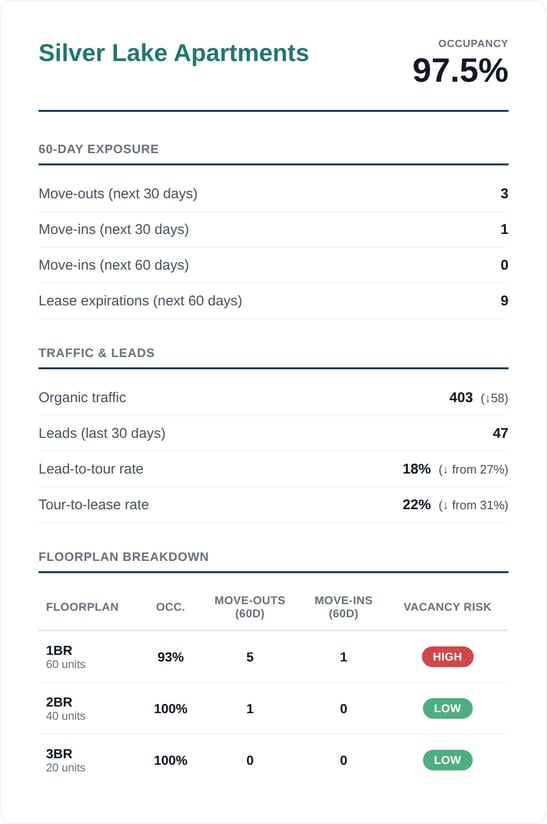
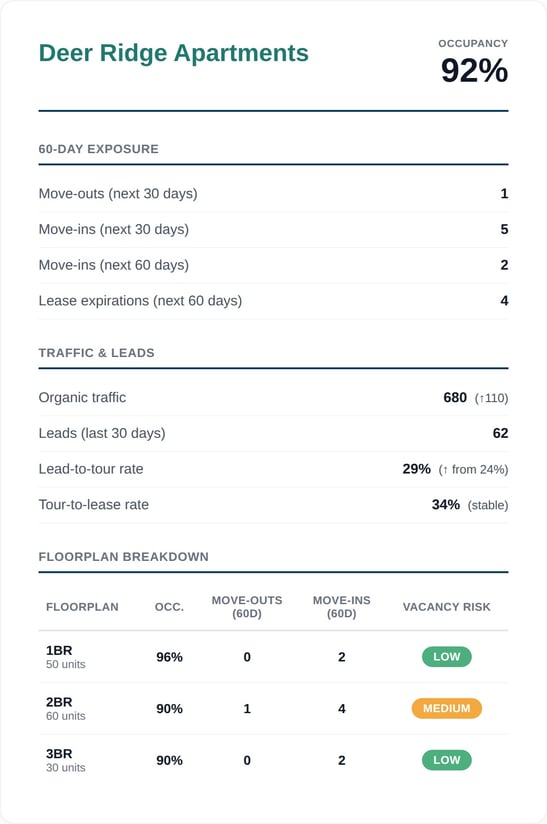
The answer: Silver Lake Apartments.
Did you see what was happening below the surface?
Silver Lake's 97.5% occupancy today looks strong compared to Deer Ridge's 92%, but that number is a lagging indicator hiding several problems and does nothing to explain what's coming.
Organic traffic and leasing performance are both slipping. Nine expirations are coming in the next 60 days, so its exposure risk isn't just the three confirmed move-outs coming in the next 30 days. If nothing changes, the community's performance is going to take a massive hit that forces concessions and reactive spending increases to get out of.
Meanwhile, Deer Ridge's traffic is climbing, a sign of higher demand. Leads are better-qualified, as lead-to-tour and tour-to-lease conversions are strong. With seven scheduled move-ins compared to only one move-out coming in the next 30 days, there are no major exposure risks coming. The community is going to climb to 97% occupancy on its own.
That's just the community-level outlook; the floorplan details make ad prioritization even clearer.
Vacancy risks almost always start smaller, at the floorplan or bedroom-configuration level first. For Silver Lake in this scenario, it doesn't need more broad ad support when its vacancy exposure risk is mainly concentrated within its 1-bedroom floorplans. Five of the six upcoming move-outs are happening there, while the two- and three-bedrooms are full.
Deer Ridge's floorplans also vary in vacancy exposure risks, but future move-ins will absorb it. The only ad support that may be necessary is for its 2-bedrooms.
Here's one possible way you could allocate your advertising efforts between these communities:
- Increase ad spending on Silver Lake's 1-bedroom ad campaigns.
- Pause or reduce spending on Silver Lake's other floorplan campaigns.
- Maintain current spend on Deer Ridge's 2-bedroom campaigns.
- Pause or reduce spending on Deer Ridge's other floorplan campaigns.
- Maintain or increase spending, as needed, on Silver Lake's community campaigns to make up for lower organic traffic.
- Maintain or reduce spending, as needed, on Deer Ridge's community campaigns.
This is why it's better to follow leading indicators like vacancy exposure and upcoming supply and demand for knowing where to prioritize your advertising efforts. It prevents you from giving equal ad support to a stable property and one that's about to nosedive, and from giving equal ad support to floorplans within the same community that need completely different things.
All of this sounds simple, only in theory. But we've only looked at the current and future performance of two communities and six floorplan groups. Now imagine doing this across 15, 50, 100+ communities and their floorplan groups every week, with their data shifting daily?
That's the reality of managing digital advertising that works ahead of demand across a multifamily portfolio.
Account for each community's unique leasing needs
In addition to understanding upcoming supply and demand data to diagnose where ad support is needed, you must also account for other factors like a property's class, size, lifecycle stage, and market position. No two properties will ever need the exact same leasing support at any moment in time.
Let's run another scenario that accounts for those factors to determine how to address their leasing needs.
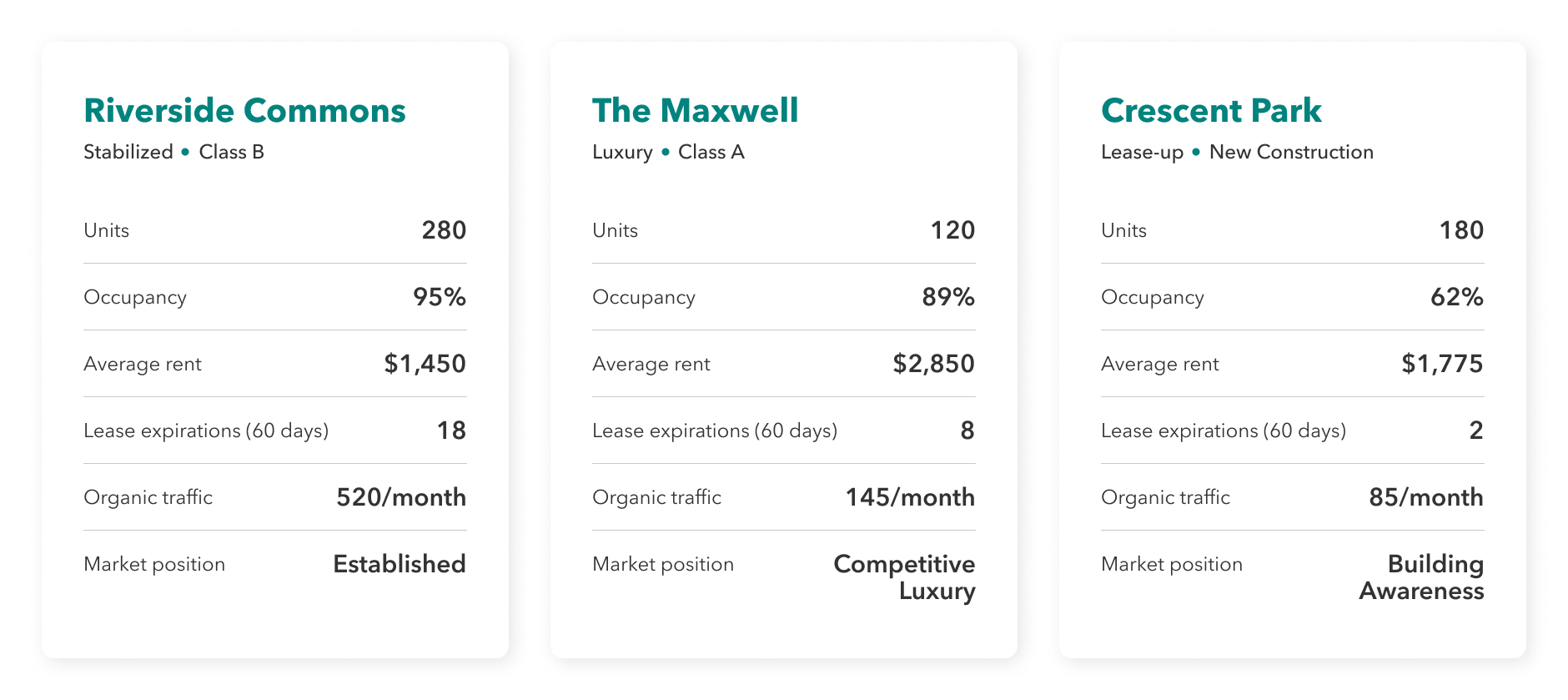
Riverside Commons is a stabilized, B-class property with steady occupancy, strong organic demand, and manageable turnover. Even though it's a larger property, it only needs ad support when necessary.
The Maxwell, a luxury community, needs considerably more advertising support. Premium properties require sustained ad investment, even when vacancy risks are lower, because luxury renters go through longer decision cycles and the market is highly competitive. When multiple luxury communities are trying to capture the same audience, CPCs also tend to rise.
Then there's Crescent Park, which is currently in a lease-up. Any property still in that stage requires 2.5-3x more investment in ads than normal until their units are full.
This is why the principles of ongoing oversight and flexible budgets are essential to portfolio-level ad management. Every property has different baseline needs, and those needs shift constantly.
How do I target my apartment's digital ads to the right prospective renters?
The next tactical challenge facing portfolio marketers is targeting their ads in front of the right renters at every stage of their apartment search.
To do this, you need to determine who sees your ads based on their behavior, leasing intent, location, and prior engagement with your communities. Let's break down each targeting segment:
Behavioral targeting
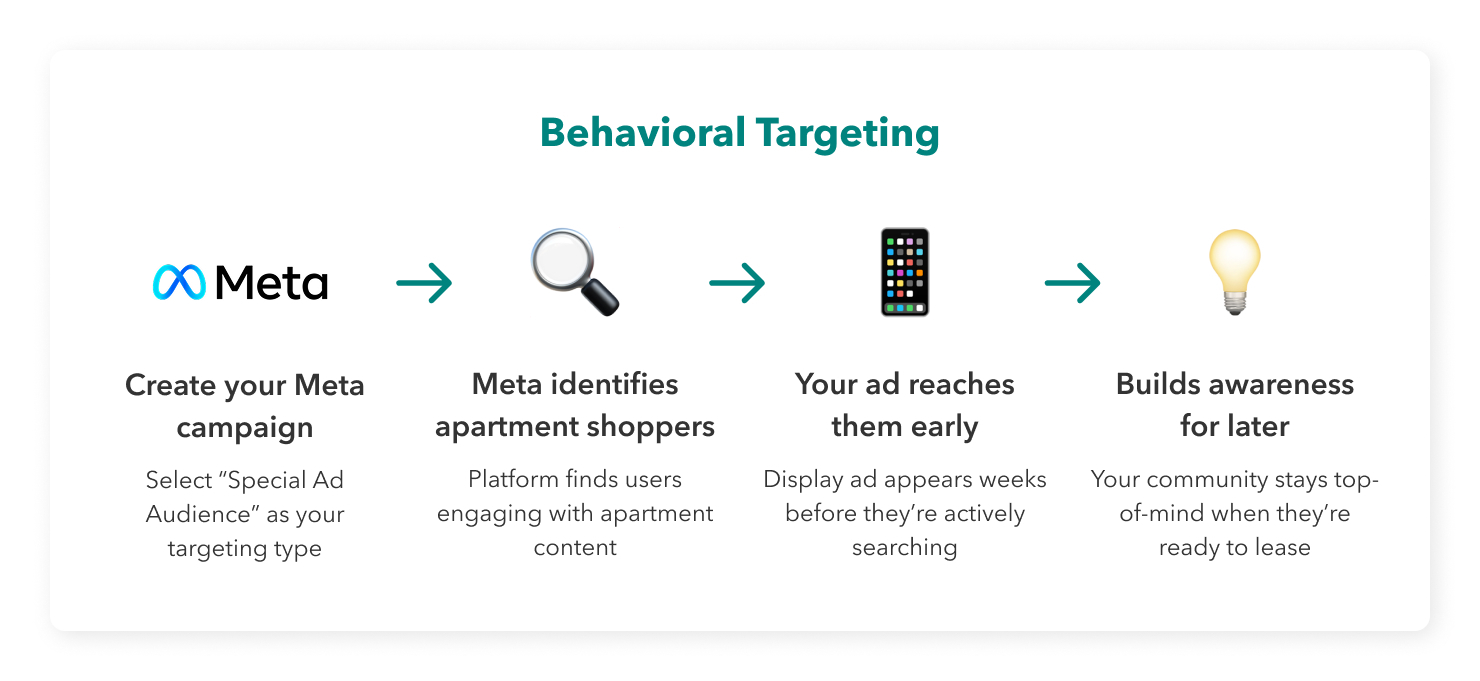
Behavioral targeting occurs mostly with Meta, delivering ads to reach future renters who are at the earliest stages of their apartment search.
These individuals may be months away from moving, but they're watching New York City apartment tours on YouTube, looking up "best places to live in NYC", and engaging with their friend's video showcasing her new apartment's layout on Instagram after she relocated to the Big Apple.
Based on these behavioral patterns, Meta would categorize a user as an apartment shopper. Getting an ad in front of individuals like these builds awareness early for your communities to stay top-of-mind when they're ready to lease.
At portfolio scale, behavioral targeting becomes especially valuable because it builds a pipeline of future renters across your entire regional footprint.
Intent targeting
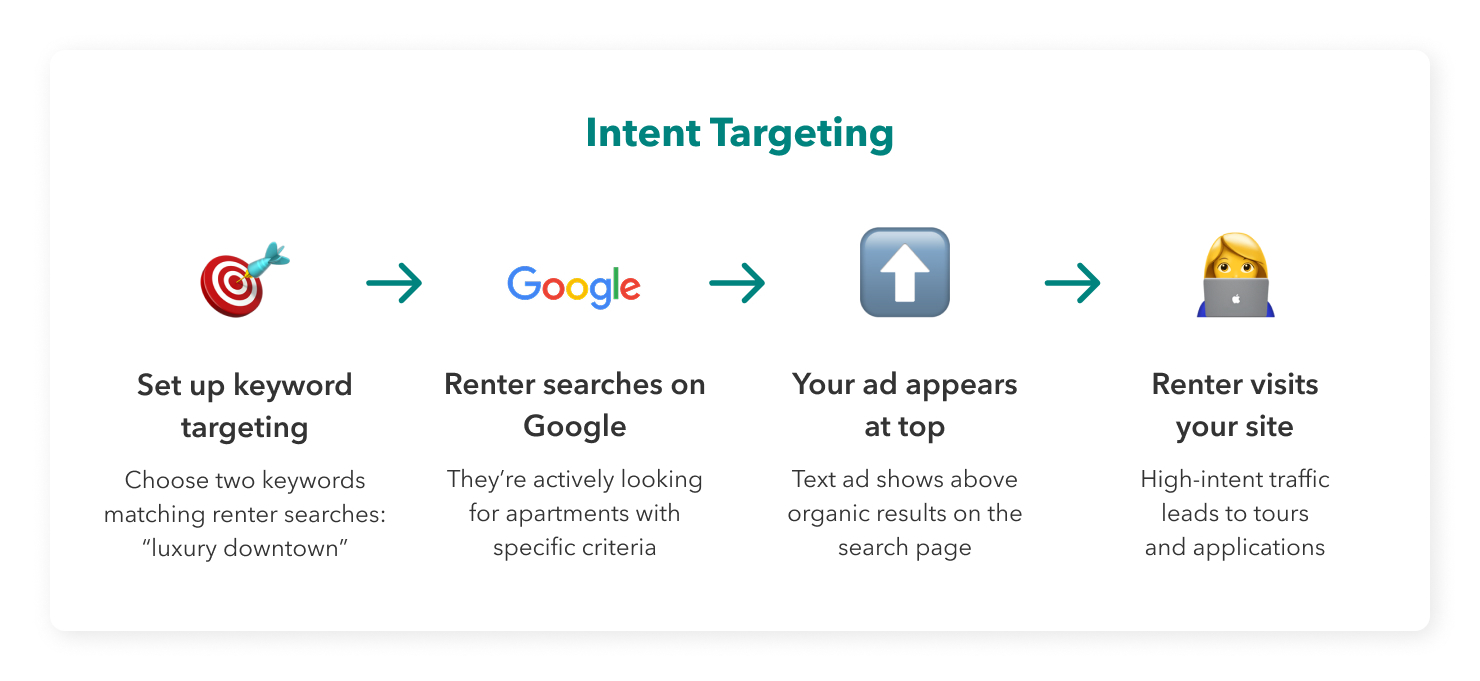
Intent targeting is about capturing renters when they're ready to lease and directing them to your community website. That's where your Google Ads must shine.
The keywords renters enter into queries signal their leasing intent, They're revealing exactly what things the renter is looking for. When renters reach this stage, your ads need to appear in searches for communities with your floorplans, features, or location.
Every community in your portfolio is different. If you have many properties in the same regional area, it's best to differentiate your targeting parameters and bidding to ensure each community gets the visibility and traffic it needs—and that your properties aren't competing against each other for the same searches.
→ How to Choose the Right Keywords for Your Apartment's Google Ads
Geotargeting
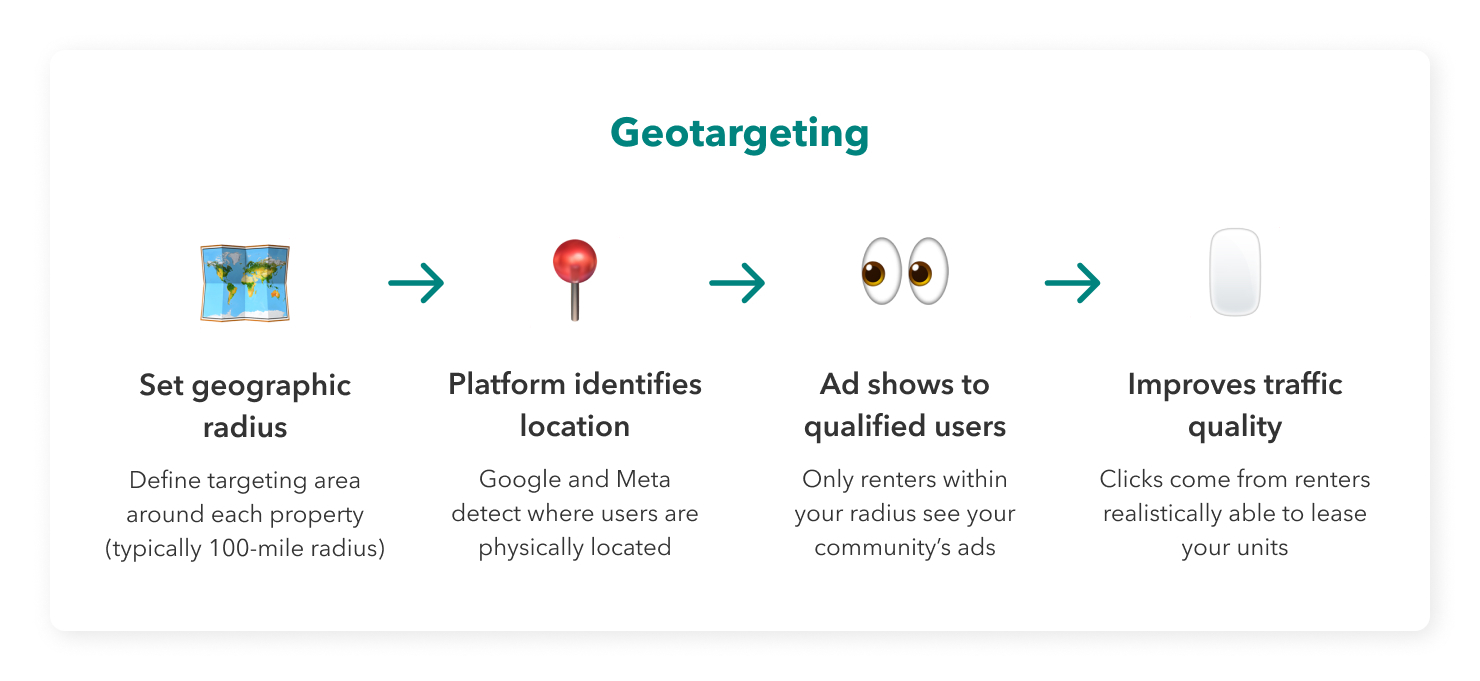
Where your ads are appearing affects the quality of traffic since most renters typically move within 100 miles of their current location. Geotargeting defines the geographic area in which your ads can be shown, ensuring you're reaching the most realistic audience of renters who'll move to your communities.
Without proper geotargeting in place, you'll get clicks from renters in Nebraska for your communities in Washington, paying for less qualified traffic that compounds across your portfolio.
If you have multiple properties in the same region, you'll need to go into each individual campaign for every property and avoid overlapping your geotargeting radius. That creates internal competition, where your own communities are bidding against each other for the same renters.
→ How to Get Geotargeting Right for Your Apartment's Digital Ads
Remarketing
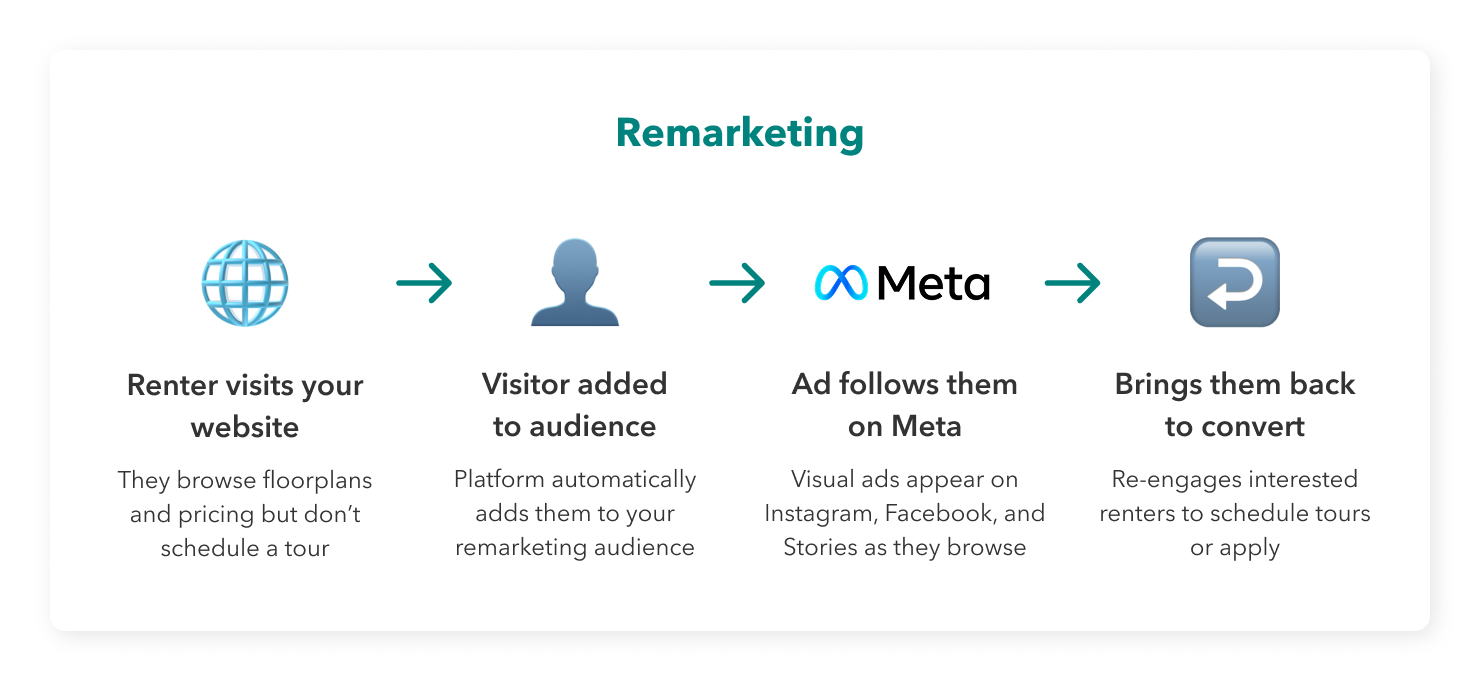
It's unfair to expect renters to schedule a tour or apply after their first click, especially when they're early in their apartment search and exploring multiple options.
Remarketing triggers ads to those individuals, keeping your communities visible during the most competitive moments of their journey. Remarketing works on both Google and Meta, but it's especially powerful on Meta's visual platforms like the News Feed, Instagram, Stories, and Reels because they place photos and videos of your community, floorplans, and features in ads to renters who are already familiar with them.
At portfolio scale, remarketing becomes a safety net across every property. Renters who click on one community's ad but don't convert can be re-engaged with ads for that same community, preventing lost interest across your portfolio when renters are comparing multiple options simultaneously.
→ How Remarketing Ads Keep Your Apartments in Front of the Right Renters
How do apartment websites impact scaling digital ad performance?
Managing your portfolio's digital ads is just one part of your job. Your websites and visual content are their own challenges, but they also directly impact how well your ads perform. Let's start with your community websites.
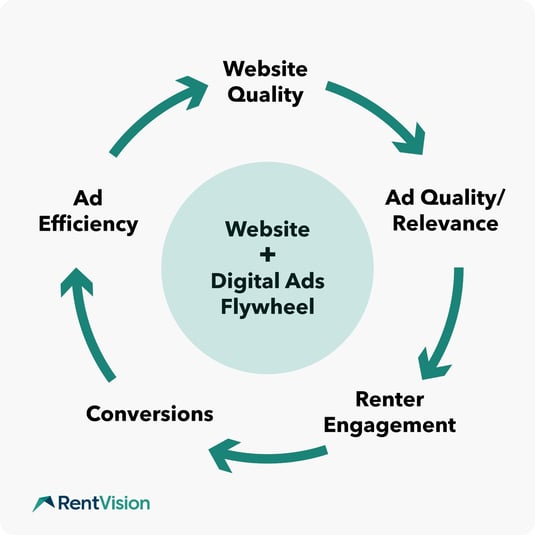
Strong ads mean nothing if your websites can't convert the traffic the ads deliver.
One of the challenges with managing ads at portfolio scale is the website inconsistencies that often exist across properties that are outside your control, especially if you're marketing for a third-party management company, working with multiple owners, or lacking final decision-making authority.
Here are some apartment website inconsistencies that routinely crop up and impact ad performance:
Inconsistency #1: Different website platforms or design across properties
Some properties have boutique websites built by a vendor while others are still using the layouts their CRM provided. One community's website looks modern, loads fast, and works well on mobile devices while another is failing every Google Core Web Vitals metric.
Ads can't erase the gap in performance between those two websites. That makes it even more complicated to give each community the leasing support it needs.
Inconsistency #2: Floorplan presentation
Some websites have floorplan pages for each configuration, showing photos, video tours, pricing, and availability details in one relevant place—creating an ideal landing page to direct floorplan ad campaigns.
Other websites rely on a standard page that has every floorplan featured, alongside generic galleries that aren't identifiable by a particular layout.
From an ads standpoint, these discrepancies affect engagement and how conversions are counted, creating misleading or overinflated performance metrics that hinder your efforts to make the right adjustments.
Inconsistency #3: Outdated or missing pricing or availability information
In order for renters to take conversion actions, they need to see both rent prices and unit availability.
Across multiple communities, data silos, disconnected platforms, or systems that don't sync in real-time can result in outdated pricing and availability on your websites.
Though you're responsible for what appears on your site, you often don't control pricing decisions or revenue management tools, leaving you unable to fix a bottleneck that's preventing qualified visitors from converting.
Naturally, these inconsistencies with websites result in fewer conversions and make your ads appear less effective. This is hard to explain when the problem isn't the ads themselves, but what's happening after the click.
→ The Apartment Website + Digital Ads Flywheel: How Performance Lives or Dies on This Connection
What impact do virtual tours and photos have on scaling multifamily digital ads?
Having high-quality virtual tour and photo content displayed across your communities' ad campaigns clearly impacts renters who are searching for their next apartment.
But at portfolio scale, it's really challenging to maintain visual consistency across multiple campaigns. Some properties may have recently refreshed their photos and video tours while others are working with outdated images—or lack floorplan-specific media entirely—which impacts campaign performance.
As a result, some portfolio marketers turn to AI-generated visuals or stock imagery to fill the gaps. But embellished visuals will backfire because renters are savvy. Photos or videos that don't match reality erode trust faster than inconsistent ones do.
Here are ways to scale your photos and videos for portfolio advertising that avoid those pitfalls:
Use real photos
Renters want real photos and videos of your communities. Having professional, consistent media showcasing your units and amenities across your digital ad campaigns sets the right expectations and better qualifies the clicks. As your communities get compared to others, using real media content becomes a competitive differentiator by establishing clarity and trust—which is a baseline renter expectation.
Have visuals for every floorplan across all properties
Without floorplan-specific visuals, you can't run effective floorplan campaigns at scale. An ad about your 2-bedroom floorplan with a photo and video of that floorplan will appear as highly relevant to renters searching for it. More visuals per floorplan also helps you avoid ad fatigue—declining performance as a result of renters seeing the same visuals repeatedly.
Include lifestyle and amenity shots that reflect the actual property
If you manage both luxury and affordable communities, your ad creative should immediately signal which tier each property represents. Renters should be able to tell from your visuals whether a community is luxury or affordable, or whether features like pet-friendly units actually exist.
Use actual video tours in Meta campaigns
Video tours aren't just meant to be seen on your website. You can utilize them in highly visual platforms like Meta Ads, where videos far outperform static images in engagement.
The point of scaling your visual content alongside your digital ads is to avoid discrepancies between communities. When some properties' ads perform well and others don't, outdated or low-quality media content is often the difference.
When does it make sense to outsource your portfolio's digital advertising?
Do you have 30 hours of your week available right now to dedicate to managing your portfolio's digital ads? Can you take everything we've shared so far in this guide and truly establish daily, ongoing ad maintenance and vacancy forecasting to address what every single property needs?
The reality is that most portfolio marketers are already overwhelmed and don't have the bandwidth to scale digital ads on their own without outside help.
It's not for a lack of expertise; it's simply about bandwidth. Managing ads for five communities feels doable. Then your property management company acquires five more, develops another, and just keeps growing. Now you've got 50-100+ properties on your plate.
You're drowning in reporting, adjusting budgets, and putting out fires. Decisions start to feel like guesswork. The landscape keeps changing—ad platforms, renter behavior, tracking updates—and staying on top of it all becomes unsustainable.
Eventually, it leads to a breaking point. If you're at that point, start here:
→ In-House vs. Outsourced: What's Best for Multifamily PPC?
→ What To Look For When Choosing A Multifamily PPC Advertising Company
What does it look like when your digital ads start preventing vacancy—not reacting to it?
No two communities in your portfolio, nor their floorplans, share the same need for demand or awareness. But continuing on with static digital ad budgets treats every property the same, resulting in wasted ad spend and excessive traffic for stable communities while at-risk ones struggle for leads.

To get out of that firefighting mode requires daily management and decision-making so each community gets the support it needs now based on future risks, not today's occupancy.
You've reached scale when you stop reacting to vacancy and start anticipating it. Your ads drive traffic at the right time, not after a rush of notices. You save money by not spending the same amounts for communities at 98% occupancy as ones at 84%.
But as we've shown, getting to that point of knowing where to prioritize your advertising efforts and stay ahead of demand is extremely challenging. There's simply not enough time or focus to manage daily maintenance on your own as your portfolio's needs keep growing. We designed Predictive Advertising exactly for multifamily marketers like you who've run up against this obstacle.
It integrates directly with your PMS to read the vacancy exposure or every community, floorplan, and bedroom configuration in your portfolio, then automatically adjusts spending and campaigns daily to address those risks before they impact performance.
If you're ready to move on from reactive firefighting to demand-aware digital advertising at scale, let's talk. Schedule a demo to see how Predictive Advertising works for your portfolio.