The Apartment Website + Digital Ads Flywheel: How Performance Lives or Dies on This Connection

Headshot of Michael Zimmerman
Featured blog post image

You hop on Zoom for your organization's monthly performance check-in. The PMs, regionals, and owners are all seeing the same issue as you—inconsistent leasing performance between properties—and they're wanting answers.

You try to explain that traffic numbers are looking better after you've increased ad budgets for the struggling communities. But everyone on the call is looking at leads and leases. They're still flat. Deep down, you know something feels broken.

You spend the next few days diving into Google and Meta, applying new messaging to search ads, updating media assets, defining target audiences, and changing the daily budget. 

That's the normal reaction when cracks start to show in a property's performance. But "just fix the ads" means more money and hours get burnt, because there's usually more to the story.

When was the last time you checked your community websites?
How are they performing?
How is the traffic being sent to them engaging with the content? 

This is the link that often gets overlooked by apartment marketers when things aren't working. It's called the Apartment Website + Digital Ads Flywheeland understanding it matters the next time you're trying to explain (and solve) inconsistencies across your portfolio.

What Is The Apartment Website + Digital Ads Flywheel

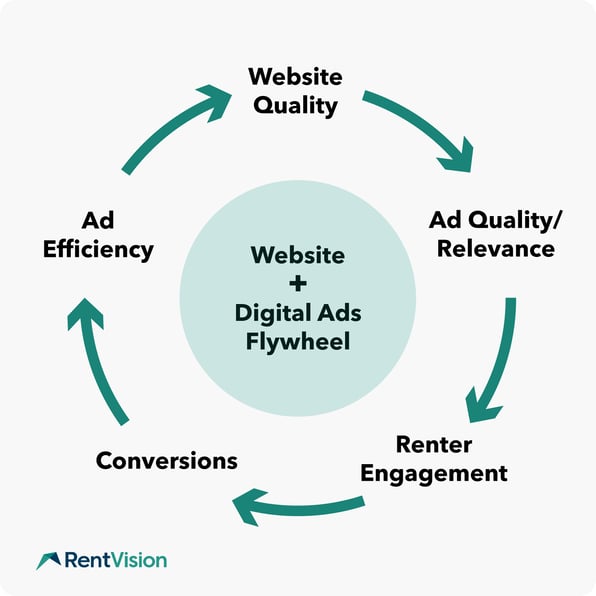
Diagram illustrating the Apartment Website and Digital Ads Flywheel, showing a circular loop between website quality, ad relevance, renter engagement, conversions, and ad efficiency, with “Website + Digital Ads Flywheel” centered to represent continuous performance improvement.

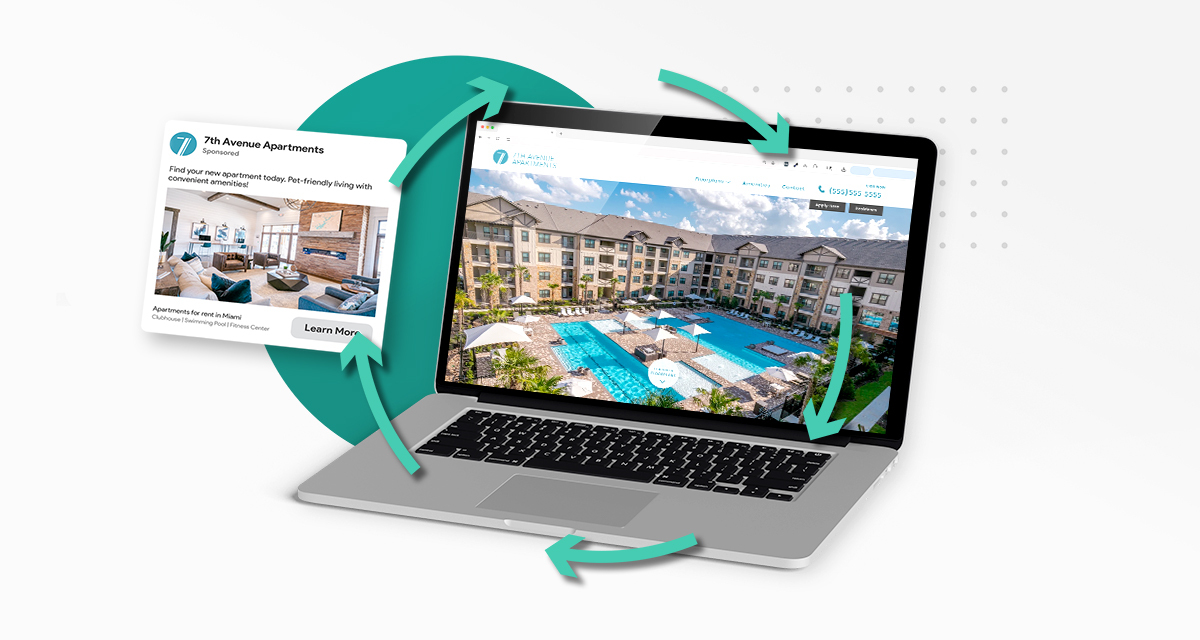
The Apartment Website + Digital Ads Flywheel represents the direct connection between the quality and content of your website and the performance and outcomes of your digital ads

Every click on an ad and every visit to the website impacts when your ads appear, who sees them, who engages with them, how much they cost, and what actions they take on your community website. 

Why Apartment Marketers Miss This Critical Connection

The problem is that apartment marketers often tend to treat websites and digital ads as two separate channels. Ads "just drive traffic." Websites "just collect leads." That's where the Flywheel breaks. 

One subtle, costly example? Your ads get daily, weekly, and monthly assessments and changes while the website doesn't get updated for months (or years). Paying money to drive more traffic to a neglected apartment website is a recipe for wasted spend and stalled performance. 

Yet without understanding the Flywheel concept, many portfolio marketers blindly continue choosing that option—and then have a hard time explaining why traffic, leads, and lease counts aren't aligning.

The more it continues, the more communities are forced to retreat into offering concessions and price drops to drive demand and leases. It's the stuff that drives executives mad.

The reality is that your apartment community's website and digital ad campaigns are constantly working and influencing one another. That's what the Flywheel illustrates—and we'll dive into how it works next.

How Apartment Websites and Digital Ads Work Together

1. Website Quality Determines Ad Relevance

The success of your apartment's digital ads doesn't start with your budget, targeting techniques, messaging, or visuals.

It starts with the content and performance of your community website.

Each ad platform you use is incentivized to provide the most relevant and quality ad matching what end users are looking for and points them to a website addressing those needs. 

Your ads are given a ranking based upon those two things. So if your ads feel like they're turning into money pits with little proof of leasing success, it's likely because:

  • Every individual ad just points to your community website's homepage (or you only have one page dedicated to your community on the corporate site)
  • Your website is missing critical content renters are looking for
  • Your website looks outdated
  • Your website is too focused on branding and aesthetics—not leasing performance

Before spending time and money on ads, you need to set the foundation for a high-converting apartment website. One that features renter-centric content making it easy for prospects to get the information they need to make a leasing decision.

That means:

  • Having comprehensive, organized details about every floorplan, amenity, pricing, availability, location, and more—along with visual content.
  • Structuring around pages for each floorplan with those comprehensive details included to use as landing pages for specific ads.
  • Speaking to your target audience instead of using vague, exaggerative messaging.
  • Ensuring it loads fast, works on mobile, is accessible, and is easy to use.

When those things are covered, it sends the right signals to whichever ad platform you're using. That's step one for getting the Flywheel turning.

2. Ad Relevance Shapes Renter Engagement

Of course, when renters are in the midst of their search process and come across one of your apartment community's ads, they're not thinking about performance or quality of your website. 

They're only able to judge your ad's headline, description, and visuals to decide if your apartment fits their needs and interests them.

But earning their click doesn't solely determine an ad's success; it's based on what actions they take afterward. 

The baseline expectations today's renters have for apartment websites are:

  • Seeing floorplan-specific visuals showing the inside of your units
  • A complete list of amenities with supported images
  • Information about your location and nearby attractions
  • And more than anything else, real-time unit availability and transparent pricing

That's why you need to pay close attention to how renters who clicked an ad behave on your website. Are they leaving in seconds, or staying longer? Look at your website's bounce rate, time on site, floorplan page views, engagement time, video views, and similar metrics to measure the quality of traffic coming from your ads.

Gaps between how many clicks an ad generates and what visitors do on your website signal a disconnect in the Flywheel. You end up paying several dollars per click for renters who leave in seconds because the site doesn’t immediately confirm what your ad promised.

Again, it starts with getting the website's foundation right and focused on what renters need. But the next step is to ensure that the content of your ad—and the page you direct clicks to—match. Not only does that make your ad more relevant, it further supports renter engagement.

3. Engagement Drives Conversions

The more renters engage with your apartment community's website, the more likely it is they become a lead who signs a lease.

That's because every time they visit a floorplan page, view a virtual tour, slide through a photo gallery, check your availability, pricing—the more familiar and comfortable they become. The more familiar they are with your apartments, the better you fare when evaluated against contending properties.

Their initial interest—that point when they first clicked on an ad—has now been verified. The next step is to have all of the ingredients in place for them to take a clear leasing action.

This is where small mistakes woven into your website can have an unintended negative impact. For example, if your main calls-to-action are "Call Us" or "Contact Us", you're actually putting up a wall that tells renters that your leasing process is gated or more difficult.

Your goal should be to make the conversion pathway simple and aligned with how renters make leasing decisions. That means more than just having a form. It includes:

  • Floorplan-level CTAs. Floorplan pages are the conversion engines of apartment websites. Capture their interest on the page that details the things they care about the most.
  • Online Applications. Let renters conduct all the same things they'd do in your leasing office while on your website. This is key as more renters choose to lease without visiting a property in-person.
  • Online Tour Scheduling. This is an actionable CTA that allows renters to set an in-person tour and finalize their leasing journey.
  • Availability-Driven Messaging. Having messaging on your website like "Only 1 Unit Remaining!" drives urgency.

While much of the focus on this part of the flywheel applies more to the mechanics of your website, the impact of conversions to your digital ads cannot be understated. 

4. Conversions Improve Ad Efficiency

Renter engagement is the first signal helping Google and Meta determine an ad's quality. When the website is generating conversions, it sends back an even strong signal to those ad platforms.

The platforms learn:

  • That the traffic they're driving to your website is very valuable
  • When, where, and to whom to deliver your ad for maximum leasing impact

It becomes less about just generating impressions and clicks and more about producing qualified leads who are proven to lease. Your ad dollars are working smarter while costs lower. 

When you've reached this stage of the Apartment Website + Digital Ads Flywheel, you're in greater control of demand, spending, and leasing performance across your portfolio.

Getting your ads to work this efficiently isn't based on how much you spend or how targeted your audience is. No amount of ad optimization can overcome neglecting the impact your website has in how renters evaluate and lease.  

Thus why the Flywheel circles back to the foundation—the content and quality of the website.

Conclusion: Don't Ignore This Essential Link in Your Apartment Marketing Strategy

Community performance lives or dies on the connection between your website and your digital ads. When cracks appear, throwing more money at ads to drive more traffic isn’t going to solve everything. You need to inspect what’s happening on your website—because it’s not a separate channel.

The Apartment Website + Digital Ads Flywheel shows that these two channels are directly linked—and that it’s only possible to accurately diagnose and solve performance issues when you evaluate them together.

At RentVision, we build apartment websites and digital advertising to function as one system—using each community’s upcoming supply and demand to adjust both together before vacancy changes.

When your ads and websites are in alignment, prospective renters show stronger engagement, conversion rates rise, and ad platforms gradually learn how to get your apartments in front of the right audience at the right time.

That means when there are changes in demand and you need more traffic and leads, you can confidently adjust ad spend for a struggling property and solve issues faster—without burning through your marketing budget.

You’re fixing the system, not just the ads—and that process scales across every community in your portfolio. 

RentVision white outline of icon

Make renting your apartments easy

RentVision enables you to generate more qualified traffic when you have a sudden increase in vacancy, and saves you marketing dollars when it’s under control.