


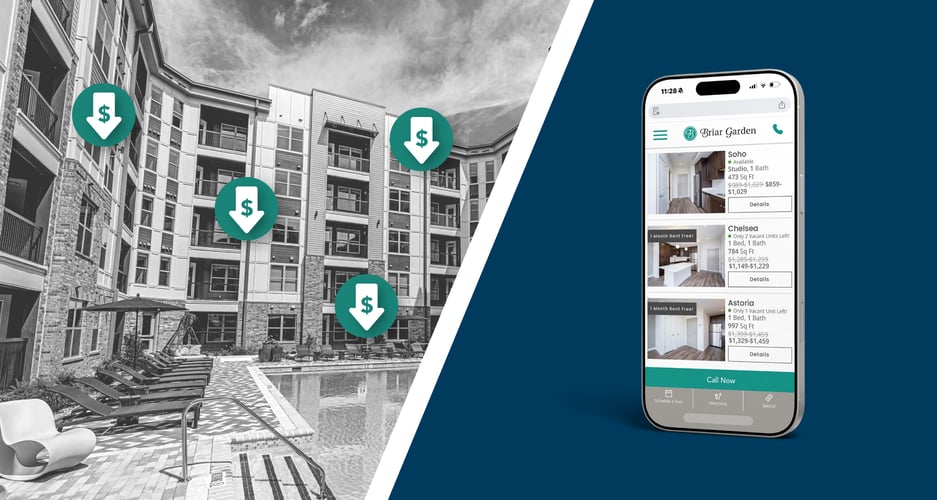
At the first sign of vacancy troubles, apartment operators often react by running a community-wide rent special.
Here's the problem: Broad specials, where every unit gets the same discount, are risky. They can make higher-demand units lease faster at unnecessarily lower rent prices, while struggling units remain vacant longer—reversing the intended effect of the special.
In a previous article, we compared community specials vs. floorplan rent specials, and it was clear that the latter was the better option for stabilized communities where demand tends to be uneven between varying layouts.
Unlike broad discounts like community specials, floorplan rent specials generate more demand and visibility only where vacancy issues actually exist, while letting you continue charging market rents elsewhere.
Defaulting away from community specials to floorplan rent specials requires a complete organizational mindset shift. You will need to change how you track floorplan performance, when and where you apply specials, how you manage those discounts over time, and how you promote them to your prospective renters.
This step-by-step guide explains how to implement floorplan rent specials and benefit from their effectiveness.
Step 1: Review Current and Upcoming Availability by Floorplan
Start with these questions:
- How many units in each floorplan are occupied today?
- How many of those occupied units are on notice?
- How many scheduled move-outs and move-ins are coming in that floorplan over the next 15-30-60 days?
This will help you see where each individual floorplan stands today and—more importantly—which one(s) will have the most exposure in the near future.
Instead of just using your community's occupancy number as the barometer for running specials, you'll start diagnosing vacancy and demand issues at the floorplan level first.
Step 2: Identify Floorplans with Elevated Vacancy Risk
After assessing their performance, you need to select which floorplans to target.
Signals That Show Which Floorplan Has Vacancy Risk
Slower leasing velocity
Are units in one particular floorplan experiencing longer vacancy durations than other layouts? Track average days vacant by floorplan.
Higher upcoming supply
How far apart is the delta between the number of occupied, on notice and vacant units and the number of occupied units? A floorplan with 5 vacant units and 8 on notice has very different exposure than one with 2 vacant and 1 on notice.
Less renter demand
How many tours, applications, or new leads are coming in for individual floorplans? What about website traffic and engagement? How are certain ad campaigns performing over others? All of these give you context into which floorplans have softer demand.
When signals mix, prioritize future supply against future demand. Whenever a floorplan's supply outweighs demand, it needs the help of a targeted special.
Step 3: Structure the Floorplan Special
Before setting a floorplan (or any) rent special, you must know:
- What is the trigger for turning on the discount?
- How long does the discount last?
- How much is the discount?
There are no universal "right" answers here. Your choice depends entirely on your property's financial goals and how aggressive or conservative you want to be in protecting occupancy.
What matters most, however, is structuring floorplan specials in a way that works for your community's needs—and that you follow through on the process.
When to Trigger a Floorplan Special
Using each floorplan's supply and demand indicators, you can calculate its current and projected occupancy.
Projected occupancies work well as thresholds for triggering a floorplan special.
For example, say you set your threshold at 93% projected occupancy. As soon as a floorplan is set to drop below that threshold, you turn on the special. You can then set additional thresholds if projections continue to drop for further increase or decrease the discount as needed.
In practice, your triggers for floorplan specials could look like this:
- 93% (projected) occupancy → 2 Weeks Rent Free
- 90% → 1 Month Rent Free
- 88% → 6 Weeks Rent Free
A Note on Small Floorplans
If a floorplan has very few units (say, 5 or fewer), one or two vacancies can cause occupancy percentages to swing dramatically. In these cases, you may get better results by setting thresholds at the bedroom level (tracking all 1-bedrooms together, all 2-bedrooms together) rather than individual floorplan layouts. This prevents small sample sizes from triggering unnecessary specials.
When to Stop a Floorplan Special
By tying your specials to specific performance thresholds like these, you're also creating automatic exit criteria: When a floorplan's projected occupancy rises above your initial trigger point, the discount comes off.
That's the step most operators miss—leading them to leave specials on indefinitely.
Knowing How Much to Discount
How much you discount is, again, entirely subjective to your preferences and goals.
If you're more conservative about protecting revenue, you could:
- Set higher occupancy triggers (e.g., 95%, 93%, 90%)
- Use smaller discount increments
- Accept that some units may take longer to lease
If you're more aggressive and want to keep units full, you could:
- Set lower occupancy triggers (e.g., 92%, 89%, 86%)
- Use larger discount increments
- Be more willing to sacrifice revenue to avoid extended vacancy
Regardless of how much you choose to discount, focus on performance and follow your preset thresholds. Adjust the discounts on floorplan specials as conditions worsen or improve, and turn them off at the right time. That's the goal.
Step 4: Apply Incentives Only Where Demand Is Softer
Let's use a scenario with two floorplans, both with 20 total units, to explain why this is the smart move.
- Floorplan A: 8 move-outs scheduled in the next 30 days, but also has 7 move-ins scheduled and 3 active applications.
- Floorplan B: 5 move-outs scheduled in the next 30 days, but only 1 move-in scheduled and 0 active applications.
At first glance, Floorplan A looks like the bigger problem because it has more upcoming move-outs. (Looking only at today's status is the trap operators fall into when setting community specials.) But when you factor in future supply and demand, Floorplan A is actually absorbing its exposure and will be in great shape.
Floorplan B, despite fewer move-outs, has weaker upcoming demand and will likely accumulate vacant units that sit longer if this issue remains. Higher upcoming supply, lower renter demand—that's the two ingredients that clearly indicate it's at risk.
Without going into the complicated math, if you were to project where both floorplans will be 30 days from today—assuming no more notices come in—Floorplan A would have a future occupancy of 95% while Floorplan B's would be 80%.
With set thresholds, the target for your floorplan rent special becomes clear.
What to Do When Multiple Floorplans Show Warning Signs
If multiple floorplans are struggling simultaneously, then a community special is a sensible option. The problem is widespread enough that even if you're discounting some high-demand units, you're making the right move for your community's overall performance and revenue.
But community specials still don't have to become the default option when multiple floorplans are struggling. With your triggers in place, you're able to apply multiple floorplan discounts simultaneously.
Some floorplans that are slightly below threshold may get a moderate discount compared to those with higher exposure. Having more than one floorplan special active still means you're incentivizing renters and leasing units faster while charging full market rent on high-demand units.
Step 5: Promote Your Floorplan Rent Specials
Many apartment operators still default to community specials because they're easy to manage and promote. One marketing message. One universal discount for your team and renters to remember. Every unit gets equal treatment.
Floorplan specials require a different promotional approach. You're no longer offering one blanket discount, so prices will look different across multiple floorplans.
Avoiding Confusion is Critical
It's important that you've structured your specials in a way that's easy for renters and leasing teams to understand.
While the type of discount you run is—again—your prerogative, it may be helpful to use a "free rent" structure for your floorplan specials, like this:
- 2 Weeks Rent Free (smaller discount for minor exposure)
- 1 Month Rent Free (standard discount for moderate exposure)
- 2 Months Rent Free (aggressive discount for severe exposure)
It's not that dollar-amount discounts ($500 off, $1,000 off) don't work, but they may be harder to calculate or remember when multiple floorplan specials are active.
Renters also tend to better understand incentives based on a "free rent" structure. The less confusing your specials are, the easier they are to promote.
How to Feature Floorplan Specials on Your Website
Floorplan specials on your website should only be promoted:
- On the individual floorplan page
- On the floorplan card on the homepage
- Where all floorplans are listed
Promoting a floorplan-specific special in a widely-visible banner on every page of your website makes renters assume that the discount applies to every unit. When they see "1 Month Free" and find out that incentive doesn't apply to the floorplan they're interested in, it creates a negative experience.
How to Feature Floorplan Specials in Your Digital Ads
To get the message about your floorplan special in front of in-market renters, it's best to have ad campaigns active for each of your community's floorplan layouts.
When a floorplan special is active, you can adjust the ad copy or creative assets in its specific campaign to highlight the latest incentive. Just be sure you're updating ads at the same time you're updating your discount to avoid price mismatches.
How to Communicate Floorplan Specials to Prospects
Most renters are accustomed to community specials. They don't understand why one floorplan would be less expensive than another. This is where you need to train your leasing teams on how to communicate what floorplan specials are and how they impact prospects.
Your leasing staff needs to clearly understand your occupancy thresholds that trigger a floorplan special. That gives them clear, important context to pass along to prospects. They can explain that the differences in prices have nothing to do with the quality of floorplans, but about their upcoming availability.
The goal is to help renters understand that the special isn't an act of desperation to get them to lease an undesirable floorplan, but a reason to act now while prices are lower. If they wait, more units will fill and the floorplan's value will increase.
The Challenges of Implementing Floorplan Specials
Floorplan specials work, but implementing them takes a lot of manual focus and effort.
- You're constantly monitoring each floorplan's performance and tracking its upcoming supply and demand.
- You need to make regular pricing updates as conditions change, sometimes across multiple floorplans. It's hard to even imagine scaling that work beyond one property to an entire portfolio.
- You need to be disciplined about following your thresholds and making timely adjustments—while also coordinating with your leasing, marketing, and revenue management teams.
This is why it's harder for apartment operators to adopt floorplan specials instead of community-wide ones.
They know floorplan specials work better for their occupancy and revenue goals, but they either can't get the buy-in or don't have the time to make them work the right way.
That's why we built Predictive Specials.
Predictive Specials is a feature that helps RentVision clients automatically apply discounts to floorplans based on triggers they've defined.
When a floorplan crosses a preset threshold, the special turns on without needing to do any calculations, team coordination, or manual website updates.
Discounts adjust up or down weekly as exposure changes—and most importantly—automatically shut off when a floorplan's occupancy gets back above threshold.
And we make performance easy to track with floorplan-level data that shows where each one is at today and in the near future—and how your specials are impacting their progress.
Predictive Specials eliminate the hard part of adopting floorplan rent specials, ensuring discounts are used in a targeted, timely manner so leasing and revenue stay strong.
Schedule a demo to learn more about RentVision's Predictive Specials.