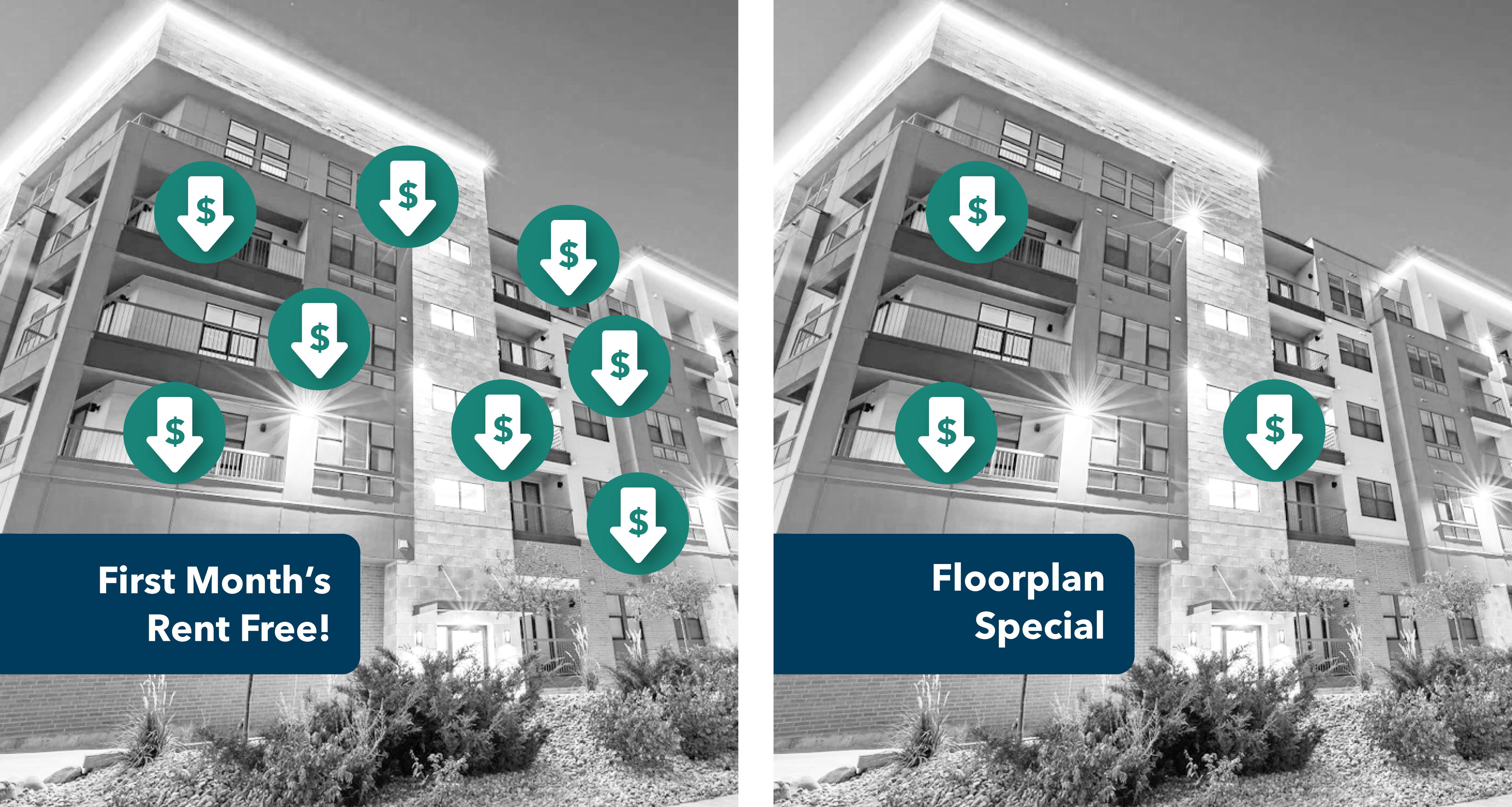
Running a rent special should never be viewed as an admission of failure. It’s a standard leasing lever that helps apartment communities address vacancy or seasonal shifts in demand—something every property experiences, no matter how well it’s managed or how popular it is with renters.
When a special is needed, most teams start with a community-wide offer because it’s easy to implement and promote. We're talking the classic “First Month’s Rent Free” or “$500 Move-In Bonus.”
Those are familiar incentives to operators and renters, and they work. But applying community-wide specials too often can create unintended challenges. It isn't the special itself—it’s the uneven demand across floorplans within a single community that uniform discounts aren’t designed to solve.
Floorplan specials, on the other hand, target vacancy gaps where they actually exist, while avoiding discounts on high-demand units that should be rented at full price.
Each type of special serves a purpose. But when additional leasing support is needed, which one should you choose? Let's break down the options.
Why Community Specials Are The Default Option
Using a community-wide special to lease units has become the default option because they're so easy to manage and communicate.
- One special
- One message
- Every unit covered
- Every new lease gets equal treatment
All you have to do is post the discount on the website's homepage, an ad, your ILS…and now in-market renters can see and (hopefully) react to it positively.
That's why as soon as there's a crack—a shift in market demand, a rash of new notices, or units not moving fast enough—running a community-wide special feels like it'll be an immediate fix.
Historically, this has been true when demand moved more predictably. (You know, leasing heats up in the summer and cools down when school starts.) Running a broad discount worked when the moment was right.
Same for when you're in a lease-up or just completing a large renovation—and need to generate a significant amount of renter demand across your entire community.
Where Community Specials Start to Break Down
In stabilized communities, however, demand issues are less broad and vary between individual floorplans. There may be a strong amount of interest for a one-bedroom floorplan, but less so by in-market renters for the 2-bedroom.
Defaulting to a community-wide discount isn't the best option for addressing these imbalances. Doing so assumes that every floorplan has the same problem, which simply isn't true.
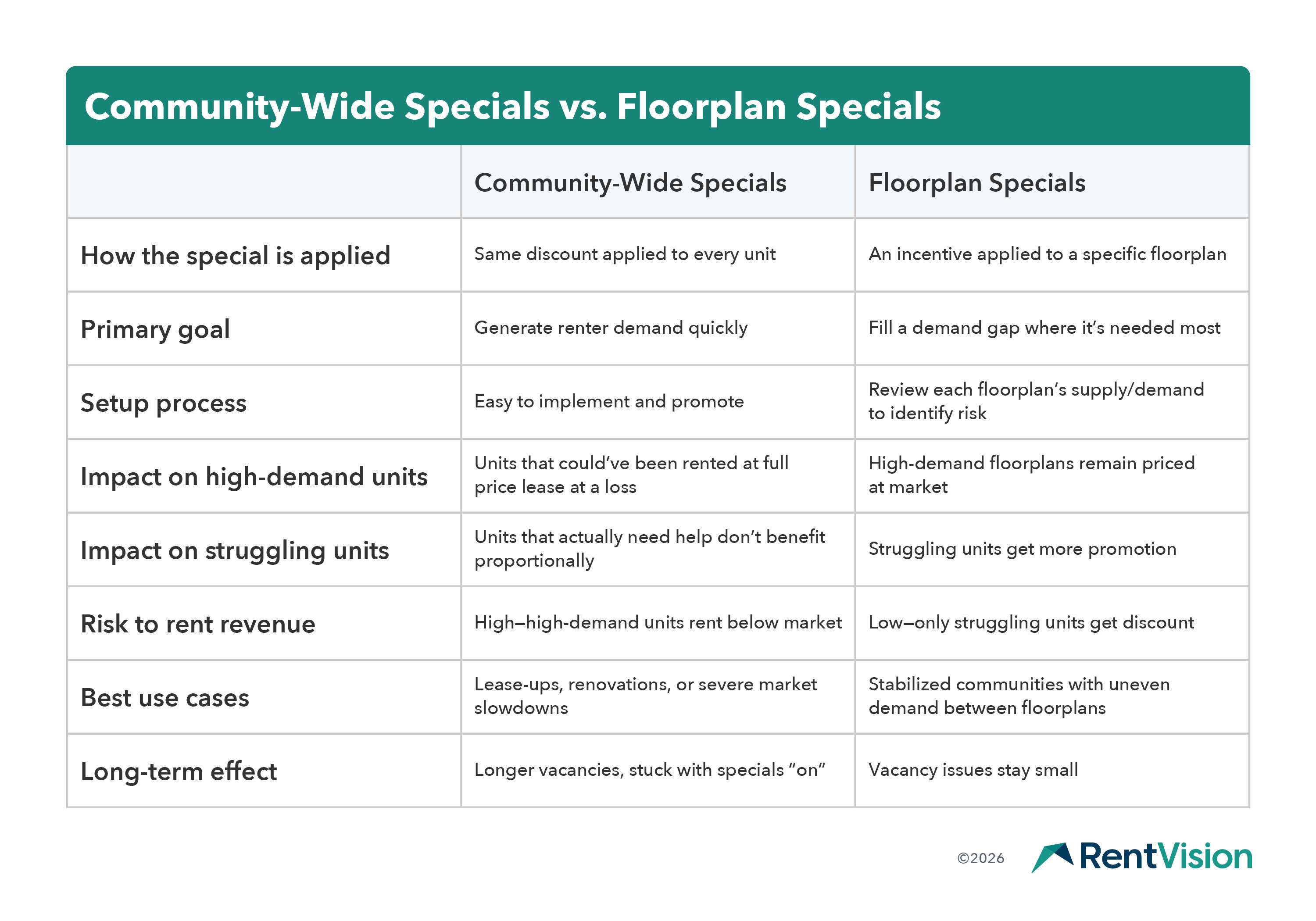
Units in high-demand floorplans that could've been rented at full price lease at a loss. And worse, units in a struggling floorplan that actually needed the help don't benefit proportionally.
When community-wide specials become the only trigger communities use to boost leasing, it leads to:
- Unnecessary losses in rent revenue
- Longer vacancy durations for struggling units
- Staying stuck with having specials 'on' since units get unequal treatment
Blanket discounts just make high-demand units more attractive, while struggling units stay vacant for the same underlying reasons—despite lowering their rent prices.
That's why floorplan specials are the right alternative.
How Floorplan Specials Provide an Alternative Approach

A floorplan special is just that—an incentive applied to a specific floorplan with more exposure, a higher number of vacant units, or soft renter demand. Unlike community-wide specials, it allows you to continue charging market-rate rents for high-demand units and protect revenue.
This discount aligns with what truly takes place within stabilized communities, where vacancy issues hardly arise at scale. They almost always start at the individual floorplan level, but remain unnoticed until the problem spreads enough to warrant a community-wide special.
When a floorplan special is the first concession lever you pull, you contain those issues to a smaller number of units that need timely, targeted discounts.
Naturally, promoting a floorplan discount does exactly what incentives are supposed to do—drive more visibility for struggling units and give in-market renters a reason to lease them.
Switching to floorplan discounts from community-wide ones as a default requires changing your behavior, but ultimately, will deliver a better outcome.
Conclusion: Floorplan Specials Should Be The Default Discount For Stabilized Communities
At certain moments, running a community-wide special is the right move. But when they become your default option at the first sign of trouble, they can have a reverse effect on your leasing and revenue.
Yes, you may get a spike in new leads or see your occupancy rise—which is great when you have a huge amount of demand you need to generate. But struggling units usually don't get the boost they need, and you sacrifice rent revenue by leasing high-demand units at discounted prices.
Floorplan specials offer a more targeted alternative, attacking vacancy problems where they really exist.
- Vacancy issues stay small
- Units struggling to lease get more promotion
- High-demand units remain priced as they should be, protecting revenue
That's why floorplan specials should become the default discount lever for stabilized communities.