


Of all the challenges in marketing a multifamily portfolio, managing constantly-shifting demand ranks near the top. One day a community isn't on your radar—the next, a wave of notices comes in. You see the problem, but it's now just one of several competing priorities across your portfolio.
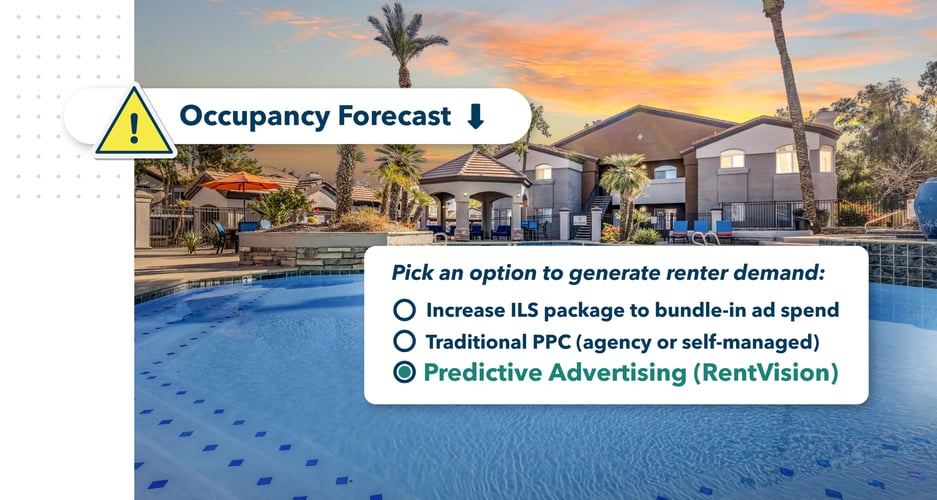
When vacancy rises or applications slow, you need to act fast. You typically have three options:
- Upgrade your ILS package to bundle in digital ads
- Rely on a traditional ad agency (outsourced or in-house)
- Use vacancy-driven automation like Predictive Advertising
All three will help you drive leads. But what works when you're marketing for only 2 properties isn't the same when you're marketing for a larger portfolio. And when your budget's already tight, that mismatch could end up costing you.
The real question is: "Which lead generation strategy scales efficiently across multiple communities and aligns spend with actual leasing needs?"
Let's break down the three primary ways portfolios generate leads today, compare where each approach succeeds or falls apart, and which choice is best for managing changes in demand.
1. ILS Ad Packages (Bundled with the Platform)
Some ILSs offer premium package upgrades that bundle in digital advertising. These ads are managed solely by the platform itself and typically promote your communities within its own network.
The bundled ads may offer placement in Google or Meta, but usually direct traffic back to the specific community's ILS listing page.
The Pros
- No additional work—just upgrade, don't manage
- Renters use ILS platforms to discover communities
- Flat-rate cost
The Cons
- You don't control the ads
- Increases awareness on only one platform
- Drives traffic away from your community website
- Targets only broad audiences, not high-intent renters
- Puts your communities in direct comparison with competitors
- Spending never changes, regardless of occupancy needs
The Core Problem
ILSs are "always-on"—generating renter demand when it's not truly needed. When you're marketing for a handful of communities, that tactic is tolerable. As occupancies increase, you can absorb the cost.
However, that "always-on" marketing tactic becomes problematic at portfolio scale.
It doesn't matter if one property is at 97% occupied and another is at 84%—both will get the same treatment. ILSs stick to static budgets unaffected by vacancy, eventually creating inequity where you're overpaying for demand to full communities while struggling ones don't get enough of a boost.
Bundling in ILS ads also competes against your own digital ads, community websites, and other marketing channels—locking you into spend that can't flex with actual leasing needs.
At portfolio scale, ILS ad packages sell exposure, not leasing outcomes.
2. Traditional Ad Agency (Outsourced or In-House)
Rather than increasing a community's presence on one platform, traditional digital advertisements can be run across Google, Facebook, YouTube, Instagram, Bing, and other sources where renters actively search.
Ad budgets can also be changed at any time to actually match leasing needs.
Together, this approach offers apartment marketers better control over where and when they're promoting communities, and how much they spend.
Some portfolio marketers can handle digital ad management in-house, but doing so requires a massive amount of time, resources, and expertise. Others outsource those efforts to agencies who specialize in PPC ads.
The Pros
- Not locked into one platform—promote across Google, Meta, YouTube, Bing, etc.
- More control over audience targeting, keywords, ad creative, and messaging
- Drives traffic directly to community websites
- Can generate early demand and capture high-intent renters
- More transparent reporting than bundled ILS ads
- Flexible budget with control over spend
The Cons
- Adjustments wait on meetings and approvals—not real-time community performance data
- Responsiveness depends on how often campaigns are reviewed
- Harder to scale ad management across properties with varying leasing needs
- Reporting transparency varies by agency
- Time, budget, or expertise constraints keep ads behind demand
- Agencies often charge percentage-based fees that increase as spend increases
The Core Problem
You're paying for people—not predictability—with traditional ad agencies.
That's because the quality of your PPC ads is 100% reliant on the effectiveness of the people running the ads—and their bandwidth to make adjustments matching real-time and future leasing needs.
Relying on a traditional ad agency (whether in-house or outsourced) may work when you're managing just a few communities, but it's still challenging to keep up with each of their needs.
However, managing, adjusting, and staying on top of campaigns for tens or hundreds of communities (and their varying floorplans) so that all of their leasing needs are met? It's nearly impossible, and wasteful of ad spend, for in-house teams or agencies with multiple other clients.
You'll keep running into the same walls: not adjusting ad spend or campaigns fast enough; not knowing what's actually working (and what isn't); staying in reaction mode after demand changes.
3. Predictive Advertising (RentVision)
Predictive Advertising is an automated, predictive system (with human oversight) that promotes your apartments across the same platforms as traditional PPC—but in alignment with each community's actual vacancy.
By connecting with a community's property management software, Predictive Ads sees upcoming availability and leasing data to forecast future vacancy needs at the community and floorplan level.
With that information, it automatically adjusts campaigns, spending, and platform allocation multiple times per day to align with future exposure—driving the right amount of traffic at the right time to your community website and saving money when occupancy is stable.
The Pros
- Automated, predictive platform that aligns ad campaigns with forecasted vacancy
- Requires little operational lift from your team
- Scalable ad software that addresses portfolio-level changes in demand
- Ad campaigns and spend adjust daily to match real-time leasing needs
- Every community, every floorplan gets the right traffic at the right time
- Flat-rate management fee with unlimited ad spend
The Cons
- Requires availability and leasing data to be kept up-to-date in PMS to support automated campaign adjustments
- Less control over the granular details of ad creative
The Portfolio-Scale Advantage
If your advertising approaches can't keep up with the amount of changing demand happening across multiple communities, you'll remain stuck in reaction mode rather than getting ahead of it. That's why portfolio scale changes everything about how you generate renter demand.
Predictive Advertising is specifically designed to scale across portfolios because it automatically adjusts ad campaigns and spending based on each community's forecasted availability and leasing data—down to the floorplan level.
That means you stay ahead of changes in demand, while every ad dollar is only used when and where it's necessary, driving more visibility and traffic to communities in a portfolio that genuinely need help.
Meanwhile, in communities where occupancy is stable, spending is dialed down to save money.
Conclusion
ILS ad packages lock you into fixed, monthly spending. Traditional ad agencies wait on human oversight of each property and manual campaign and spend adjustments. Neither can respond in real time to the actual leasing needs of every community in a portfolio like Predictive Advertising, which adjusts multiple times per day.
With Predictive Advertising, you're paying for results—only when you need them.
Ready to see what Predictive Advertising can do for your portfolio? Schedule a demo to learn more.