


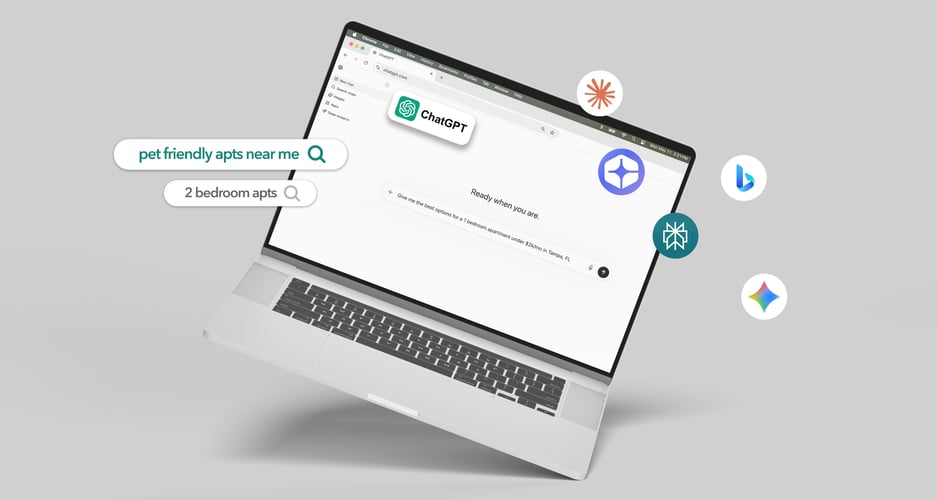
Walk the expo floor at NAA. Tune in to the multifamily LinkedIn-verse. Or view the speaking agendas at AIM and OPTECH.
A common theme that starts to emerge amongst all of the booths and slide decks: AI has already transformed the apartment search.
"Don't get caught behind—or else today's renters will never know you exist."
Not so fast, friends.
AI use among renters is real, growing, and worth preparing for—but current data doesn't support the idea that it's changed the apartment search as drastically as some in our industry are claiming.
Let's look at where AI is really sitting in the renter journey right now, and what that means for your portfolio's marketing strategy.
The majority of renters are still using traditional search platforms
AI search is far from a dominant force. Here's real, publicly-available data contradicting what many are touting right now about AI's impact on the apartment search:
- Google dominates the traditional search landscape by holding more than 85% U.S. market share as of April 2026, with Bing second.
- Google Keyword Planner shows 84% of apartment searches are still on mobile devices.
- Apartment search keyword volume remains stable. SEMRush's Keyword Magic Tool shows that variations for the generic keywords "apartments for rent near me" were used in more than 733,200 online searches between April and May 2026.
Bottom line: Google isn't dying. The majority of renters are still using traditional means to search for their next apartment, and most of their browsing is occurring on mobile. The priority of your marketing efforts should remain aligned with real renter behaviors today—being highly-visible in relevant Google searches and directing prospects to a helpful community website where it's easy to get the information they need, on any device.
Only a small segment of apartment shoppers are using AI—but it's growing
According to Zumper's 2025 Annual Renter Report, 9.8% of renters surveyed said they used an AI tool during their rental search—up from 4.4% in 2024.
Though it's a small sample size, we can't ignore this emerging base of prospective renters for whom AI apartment searches have nearly doubled in one year.
But again, current data on AI usage puts into question if this trend will continue to rise at the same rate. You should also know:
- SparkToro analyzed millions of ChatGPT user tasks. Programming assistance, professional education, and content creation ranked at the top. Much further down the list is a category labeled "Other", which is where anything potentially related with apartment search exists. It only accounted for just 3.3% of tasks. A really broad label like that makes it virtually impossible to even account for how much of those tasks could've potentially involved an apartment search.
- According to Menlo Ventures' 2025 State of Consumer AI report, the surprising super-users of AI are employed millennial parents who make more than $100,000 annually. That audience could include prospective residents at higher-end multifamily communities—but it's also a group that's typically further along in their stage of life, often prioritizing the stability and space that come with homebuying over renting.
Bottom line: We all know that in marketing, your audience matters. While you should remain vigilant if trends change, at this moment the audience of prospective residents potentially searching for apartments with an AI tool still skews small.
Why there's still a gap between AI search impact and renter adoption
AI searches still depend on traditional search.
AI search tools like ChatGPT, Claude, Perplexity, Gemini and others are not just standalone platforms with their own knowledge base or indexed content. To no surprise, these tools rely heavily on the same SEO signals as search engines when generating answers.
Multiple reports surfaced in 2025 that ChatGPT was pulling from Google's index via a third-party scraping service.
Which means much of what AI surfaces about apartments is built on the same search infrastructure operators have always optimized for. AI remains an additional layer to apartment searches, not the foundation.
AI's answers remain dramatically inconsistent.
SparkToro conducted an experiment in 2026 using more than 600 volunteers to enter the same series of 12 prompts in ChatGPT, Claude, and Gemini a combined 2,961 times. The prompts were intended to be highly-specific, including, "What are the top chef's knives, brand and model, for an amateur home chef with a budget under $300."
The result, according to author Rand Fishkin? "There’s a <1 in 100 chance that ChatGPT or Google’s AI, if asked 100X, will give you the same list of brands in any two responses…In fact, when it comes to ordering, AI tool responses are so random that it’s more like 1 in 1,000 runs before you’d see two lists in the same order."
We briefly tested this in ChatGPT, using this same exact prompt three times: "What are the top apartments in Tacoma for a family of 3 and a monthly budget of $2,500?" The first two responses had the same community at the top, but completely different communities in positions 2 and 3. The third response listed five communities that weren't even mentioned in the first two responses.
That level of inconsistency with AI should be a major red flag if you're hoping to reach more renters there.
Even AI founders don't fully understand their own systems.
OpenAI CEO Sam Altman: “We certainly have not solved interpretability.”
Anthropic CEO Dario Amodei: “When a generative AI system does something, like summarize a financial document, we have no idea, at a specific or precise level, why it makes the choices it does—why it chooses certain words over others, or why it occasionally makes a mistake despite usually being accurate.”
If the people building these AI tools can't explain how answers are generated, then there's no precise playbook for apartment marketers to optimize for AI visibility, either.
How should apartment marketers actually approach AI search?
1. Keep investing in SEO fundamentals.
Good SEO = Good GEO.
That's not from us; that's directly from Google's Senior Search analyst John Mueller.
"AI systems rely on search. And there is no such thing as GEO or AEO without doing SEO fundamentals," Mueller says. "Tricks will come out and they will work for a short time, companies that want to be around for the long term should focus on something that is proven with long term stability and not tricks."
SEO determines how your communities show up in Google and other traditional search engines, and the work to be visible there will put you in front of the majority of prospective residents. And that work underpins what AI tools also prioritize when surfacing information for their answers.
2. Focus on the content of your community websites.
The blueprint of high-converting apartment websites prioritizes pages with floorplan-level information. Make it easy for Google and AI tools to find details that renters want, like live pricing, availability, location, amenities, pet policies, fees, etc.
3. Start measuring AI traffic now.
Google Analytics is tracking referral traffic from LLMs like ChatGPT and Perplexity. This can help you get a baseline for how much traffic is coming from AI tools to your community websites now. If AI search indeed continues to double in usage annually amongst renters, you'll see if that increase in adoption. Ultimately, you would then want to see that AI traffic also produce tangible leasing impact.