When apartment marketers recognize a community is struggling to generate leads and leases, increasing spending on digital advertisements to drive more traffic is often their first instinct—and that's the right reaction.
But there's also a common misconception that driving more traffic is the only tactic or reason for running digital ads in the first place.
Apartment ads are more than just a bottom-of-the-funnel traffic lever you pull after you've identified a problem. In reality, ads have influence over the entire apartment search process—from first impression to lease signing.
The question is: Does your current ad strategy create demand and visibility for your apartments during the whole prospect journey—or just the final stages?
Let's walk through how digital ads help renters discover, evaluate, and ultimately choose your apartments.
Digital Ads and The Apartment Leasing Funnel

Today's renters undergo unique, unpredictable, and oftentimes unattributable apartment searches—bouncing between Instagram, Google, your ILS listings, and your website, multiple times before becoming a lead.
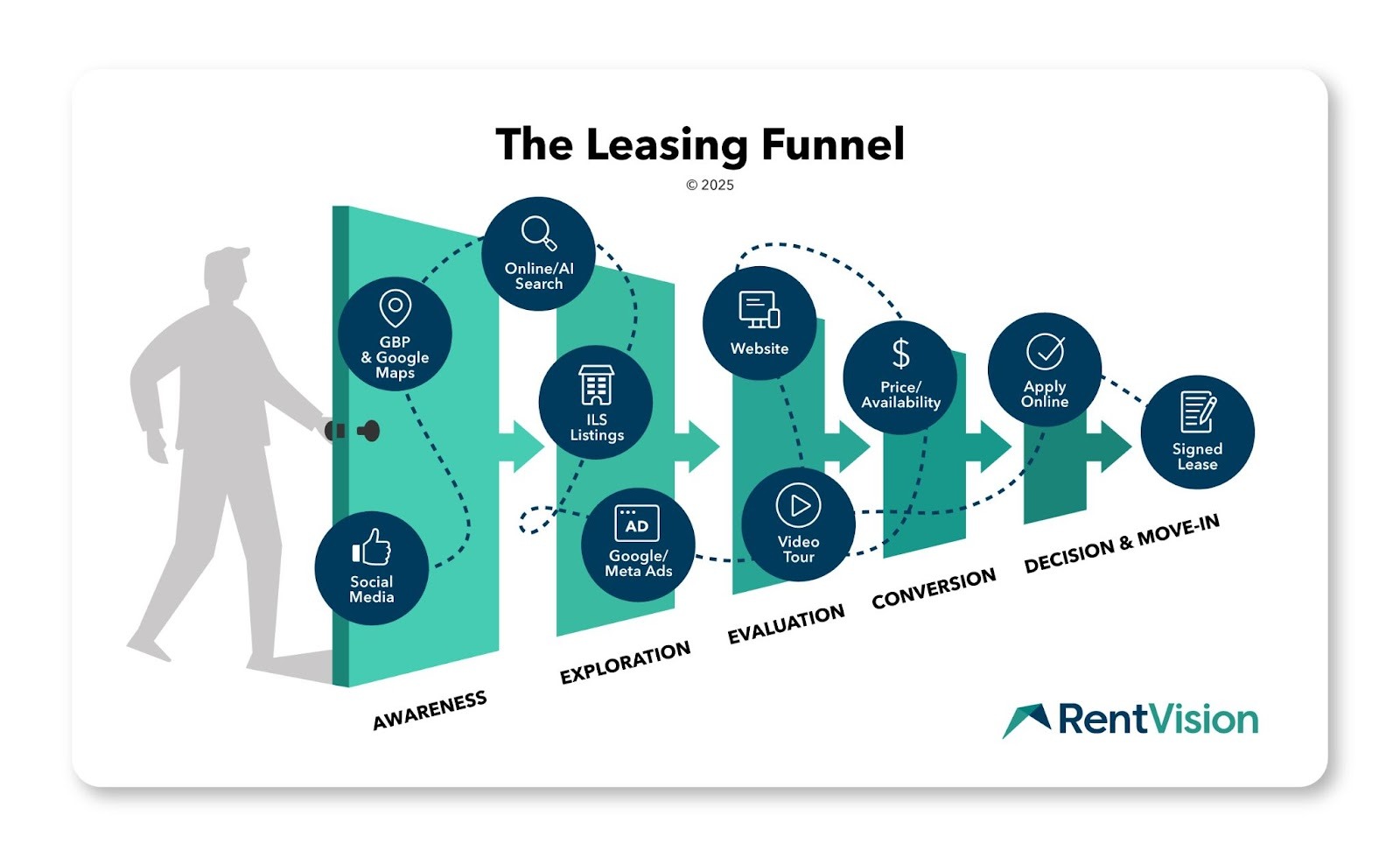
While their process may not be as clean as a traditional marketing funnel presents, renters still go through a series of distinct stages:
- Awareness
- Exploration
- Evaluation
- Conversion
- Decision & Move-In
We call this pattern the Apartment Leasing Funnel, which we detailed in our complete multifamily marketing plan resource.
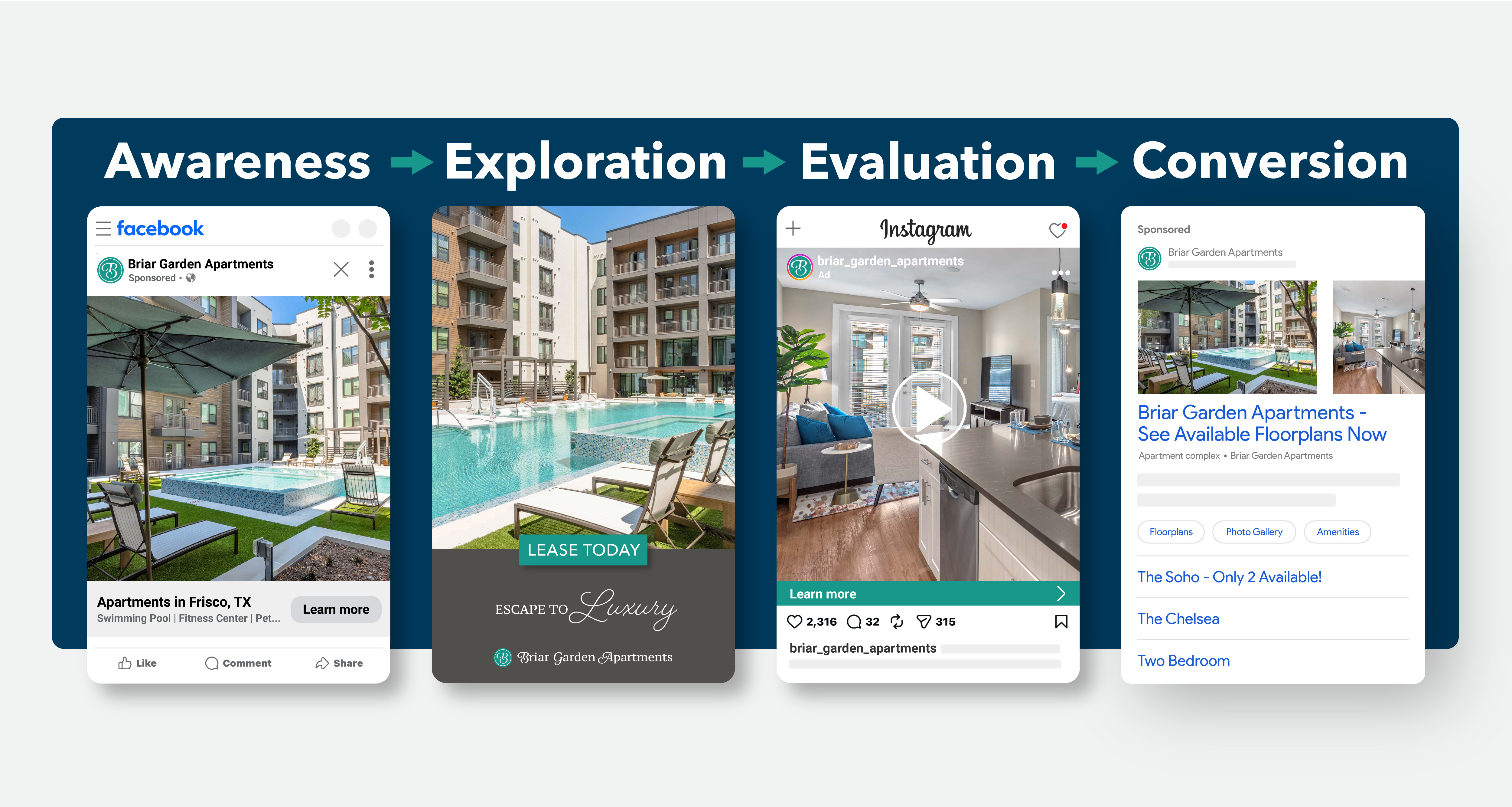
Within each stage of the apartment search, varying digital ad platforms, campaigns, and ad types play distinct roles. Let's walk through how to use ads strategically across the renter's journey so they generate early demand for your apartments and capture leasing intent at the right moment.
Awareness Stage — When Renters Are Just Starting Their Search
| Examples of Apartment Ads in the Awareness Stage | |
| Meta (Facebook/Instagram) |
|
|
|
Digital ads are influential from the very beginning of the apartment search—even during casual, low-intent moments.
For example, a renter knows their current lease is ending in six months. They haven't decided if they want to renew or move into another apartment yet, but they're keeping their options open—paying attention to what other communities are out there.
While casually scrolling social media before bed, they come across a friend's GRWM video on Instagram, where they mention their new apartment, commute to work, and nearby attractions.
Suddenly, they're curious. What apartment community was she talking about?
As they go down this rabbit trail—seeking out the community's Facebook page, watching a YouTube video about living in that city, or further engaging with their friend's videos—Google and Meta's ad platforms are absorbing signals. Their algorithms identify the renter as someone in the apartment search process due to increased engagement with apartment-related content.
A couple of moments later, they see an Instagram reel ad highlighting their friend's apartment community. A few days after that, they see a 15-second ad on YouTube featuring a similar community in that area.
They might not click on the ads—but these targeted impressions are already shaping which communities come to mind first. When they're ready to start evaluating, contacting, and touring properties, certain names will feel familiar.
Solidifying that early awareness through ads will pay off down the road.
Digital ads win at the Awareness stage by:
- Generating the earliest possible influence
- Building familiarity months before renters take action
- Creating future demand for your community by keeping them top-of-mind
Exploration Stage — When Renters Start Actively Searching
| Examples of Apartment Ads in the Exploration Stage | |
| Meta (Facebook/Instagram) |
|
|
|
Digital ads serve a different purpose in the Exploration stage. Instead of just building initial interest and familiarity like the Awareness stage, now they're actively guiding renters toward specific communities fitting their needs.
Now it's two months before the renter's current lease expires. They've just put in their 60-day notice, so they're taking their search seriously—comparing neighborhoods, checking commute times, and exploring all available communities that fit their budget and lifestyle.
They go to Google and search "pet-friendly apartments near [neighborhood] in [city]." These are keywords that, if targeted and bid for, can feature a search ad for a specific community at the top of the search engine results page—establishing immediate attention and authority.
Or they'll open Google Maps and look for apartments within specific areas to see what's nearby. Communities running Google ads with location extensions appear more prominently when they search these areas.
They browse listings on Apartments.com. Over the next few days, Meta's algorithm recognizes their apartment-search behavior, triggering ads on Facebook and Instagram for communities they've been researching.
The ads they see during this stage directly influence which communities make the shortlist.
Digital ads win in the Exploration stage by:
- Creating attention while renters are researching options
- Providing repeated exposure across multiple platforms
- Positioning communities as top contenders to be put on the shortlist
Evaluation Stage — Staying Visible While Renters Compare You to Competitors
| Examples of Apartment Ads in the Evaluation Stage | |
| Meta (Facebook/Instagram) |
|
|
|
In the Evaluation stage, the prospect has narrowed down their shortlist of potential apartment communities to three—including their friend's community that they became aware of six months ago. They've visited each community's website, checked floorplan pricing and availability, and watched virtual tours multiple times.
They've got one month before moving, and now they're ready to start taking in-person tours. They decide to schedule in-person tours with two, while they decide to hold off on the third—for now.
At this stage, digital ads keep competing apartment communities top-of-mind while in direct comparison with one another.
The property they initially chose not to tour stays in the fight with remarketing ads. The prospect sees an Instagram ad highlighting the dog park because they visited the pet policies page on the website. They watch a video on YouTube and see a quick 15-second pre-roll ad highlighting visuals of the floorplan they were interested in.
Perhaps an in-person tour with one of the properties doesn't go well. With ads keeping the other contenders visible, now the door reopens for the prospect to come back to the community website, review floorplan details and tours once again, and schedule an in-person tour with renewed interest.
Digital ads win in the evaluation stage by:
- Preventing drop-offs during the critical comparison phase
- Reinforcing initial interest and differentiators
- Keeping your community visible even if they've already toured competitors
Conversion Stage — The Final Push Before They Submit an Application
| Examples of Apartment Ads in the Conversion Stage | |
| Meta (Facebook/Instagram) |
|
|
|
The renter has visited the properties, walked the units, and met with leasing staff. One community stands above the others. But they need last-minute verification before applying.
They go back to Google and search for that community by name to find its reviews and check for red flags. They see a branded search ad at the top—a good sign. Imagine if a competitor's ad appeared instead?
On the subway heading home, they're shocked to see that same GRWM video again that their friend posted months ago—except this time it was being shared by the community's Instagram profile and being boosted as an ad.
Hearing their friend's testimonial and seeing scenes from her daily life at the community reinforces why they were interested in those apartments from the beginning.
That same evening, they're back on the community's website, verifying price, availability, policies, and other last-minute details.
Later, they browse Facebook and see a remarketing ad featuring the exact floorplan they just looked at, only this time with a timely headline: "Only one unit left!" It's the unit they saw on the website. The time to act is now. They go back to the website and apply.
Ads play a decisive role at the Conversion stage, establishing trust, authority, and urgency—three critical signals that remove hesitation and prompt renters to apply.
Digital ads win in the conversion stage by:
- Protecting your brand name from competitor ads on Google
- Creating urgency with limited availability or time-sensitive offers
- Providing social proof (reviews, ratings) at the moment of decision
The Takeaway: Your Ad Strategy Should Match How Renters Actually Search
Digital advertising is the only marketing channel that meets renters wherever they are in their unique, unpredictable leasing journey.
Whether it's Google, Facebook, Instagram, or YouTube, the ad types and campaigns on these platforms play different roles depending on the renter's stage:
- Awareness: Building familiarity when they're just starting to consider moving
- Exploration: Influencing which neighborhoods and communities make their shortlist
- Evaluation: Staying top-of-mind while they compare you to competitors
- Conversion: Providing the final push to tour or apply
Once renters reach the Decision & Move-In stage, digital ads step back because the heavy lifting is done.
Ads aren't just traffic levers for when vacancies rise. They're essential for generating early demand, shaping renter preferences, and guiding prospects toward your communities long before they're ready to apply—so that when you need to quickly generate demand, you've got an ad strategy that's already building it for you.